
Home » Practical Information » Indonesian Customs and Culture » Indonesian Holidays
Indonesian Holidays
While living in Indonesia we have many opportunities to enjoy long weekends and holidays as there are 13 national holidays proclaimed by the government. The government also declares that collective leave should be taken on some days, usually a monday or Friday, before or after a national holiday in order to create a long weekend. This policy is intended to promote domestic tourism. You can also take advantage of the fact that many hotels in tourist areas, particularly in Bali, offer special rates to ITAS holders or expatriate residents during these long weekends for great escapes from city life!
There are four types of public holidays in Indonesia: religious, national, international and commemorative. Ones that are designated tanggal merah (literally red date, or a date that is designated in red on a calendar) signify national holidays when government offices, schools, banks, and most businesses are closed.
Many of the dates of religious holidays vary from year to year, as they are based on other calendars. For example, the Muslim holidays are based on the Islamic or Hijriah calendar, which is 10 to 11 days shorter than the Roman calendar every year. Other holidays, such as Easter, Chinese New Year and Waisak are based on lunar calculations, as in other countries where these holidays are celebrated.
Cuti Bersama, or holiday together/collective leave, has expanded holidays that used to be one day so that they span several days up to a week to enable people to travel for celebrations. They are also referred to as "Hari Kejepit Nasional (or squeezed in national days).
Official Indonesian Public Holiday Schedule for 2025
- Wednesday 01 January 2025 – New Year’s Day
- Monday, 27 January 2025 – Isra Mikraj Nabi Muhammad SAW /Night Journey of the Prophet Muhammad SAW
- Tuesday, 28 January 2025 – Collective Shared Holiday (Imlek)
- Wednesday, 29 January 2025 – Chinese New Year (Imlek) 2576 Kongsili
- Friday, 28 March 2025 – Collective Shared Holiday (Nyepi)
- Saturday, 29 March 2025 – Hari Raya Nyepi and Balinese New Year Saka, the Hindu Day of Silence.
- Monday, 31 March 2025 – Eid al-Fitr/ Hari Raya Idul Fitri 1446 Hijriah / Lebaran
- Tuesday, 01 April 2025 – Eid al-Fitr/ Hari Raya Idul Fitri 1466 Hijriah / Lebaran
- Wednesday, 02 April 2025 – Collective Shared Holiday (Lebaran)
- Thursday, 03 April 2025 – Collective Shared holiday (Lebaran)
- Friday, 04 April 2025 – Collective Shared Holiday (Lebaran)
- Monday, 07 April 2025 – Collective Shared Holiday (Lebaran)
- Friday, 18 April 2025 – Ascension Day of Jesus Christ
- Sunday, 20 April 2025 – Easter
- Thursday, 01 May 2025 – International Labor Day
- Monday, 12 May 2025 – Lord Buddha’s Birthday – Hari Raya Waisak 2569 BE
- Tuesday, 13 May 2025 – Collective Shared Holiday (Hari Raya Waisak 2569 BE)
- Thursday 29 May 2025 – Ascension Day of Jesus Christ.
- Friday, 30 May 2025 – Collective Shared Holiday (Ascension Day of Jesus Christ)
- Sunday, 01 June 2025 – Pancasila Day
- Friday, 06 June 2025 – Hari Raya Idul Adha 1446 Hijriah /Eid Al-Fitr Mubarak/ Day)
- Monday, 09 June 2025 – Collective Shared Holiday (Idul Adha)
- Friday, 27 June 2025 – Islamic New Year 1447 Hijriah.
- Sunday, 17 August 2025 – Indonesian Independence Day
- Friday, 05 September 2025 – Maulid Nabi Muhammad SAW – Birthday of the Prophet Muhammad SAW
- Thursday, 25 December 2025 – Christmas Day
- Friday 26 December 2025 – Collective Shared Holiday (Christmas)
Religious Holidays in Indonesia
The Indonesian government officially recognizes five religions: Islam,
Protestant, Catholic, Buddhist and Hindu. As /images in other countries, each of these religious communities in Indonesia
celebrate events that are important to their faith. Some of these are
national holidays, others are not. The Ministry of Religion
decides the dates on which religious holidays will be held each year.
The following are faith-based holidays that are national holidays (tanggal
merah) in Indonesia:
/images in other countries, each of these religious communities in Indonesia
celebrate events that are important to their faith. Some of these are
national holidays, others are not. The Ministry of Religion
decides the dates on which religious holidays will be held each year.
The following are faith-based holidays that are national holidays (tanggal
merah) in Indonesia:
Muslim holidays in Indonesia
The dates for many Muslim holidays vary from year to year as they are based on the Islamic or Hijriah calendar, which is 10 to 11 days shorter than the Roman calendar.
Satu Muharam or Tahun Baru Hijrah - Muslim New Year - 1st day of Muharam
Marks the beginning of the new year on the Hijrah calendar.
Maulid Nabi - Birth of the Prophet Mohammad - 12th day of Rabiul Awal
Milad-un Nabi or Maulid (Mawlid) is the birthday celebration of the Prophet Muhammad. The month of Rabi’ al-Awwal (the First Spring Season) of the Islamic Calendar is well known in the entire Muslim world as Shahr al-Mawhid (the Month of Birth) of the Prophet Muhammad. The Prophet Muhammad was born in the Arabian city of Mecca on the 12th day of Rabi-ul-Awwal or the third month of the Muslim lunar year.
In Indonesia, Muslims gather to recite special prayers of thanksgiving to Allah for sending the Prophet Muhammad as His messenger. Speeches and lectures are made in mosques and elsewhere about the life and instructions of the Holy Prophet. After prayers, sweets are distributed and perfume may be sprinkled on adherents. It is also a family occasion; people dress up in their best clothing and children receive money or gifts. In some cities in Indonesia, such as Yogyakarta and Solo (Surakarta), believers celebrate the Maulid by conducting parades or carnivals, reciting special prayers and singing holy songs which they called ‘Barzanzi’. The tradition is called the ‘Mauludan Festival’. During the festival there are competitions to win food, which the people believe has been blessed by the Prophet.
Isra Miraj - Ascension of the Prophet Mohammad - 27th day of the 7th month
Commemorates the ascension of the Prophet Mohammad to Heaven. Prayers are held at neighborhood mosques.
Hari Raya Idul Fitri or Lebaran - End of the Ramadan fasting month - 1 Syawal
The end of the month of Ramadan, the Muslim month of fasting. Mass prayers
are held in mosques and large open  areas
around the country. Celebrated with the traditional dish ketupat and
visiting with family and friends. Charity donations (amal) are
traditionally given at this time. Just prior to Lebaran a mass exodus
(mudik) from Jakarta of millions of people occurs as residents
return to their villages to celebrate with family and friends. Begging
of forgiveness for any transgressions or slights in the past year is expressed
during visits, Mohon Maaf Lahir dan Batin. A Lebaran bonus, THR,
is traditionally given to all Muslim staff or employees prior to the Lebaran holiday.
In urban areas halal-bihalal (mutual begging of pardon) gatherings
are held. This is the time of year when Muslims traditionally buy new
clothes.
areas
around the country. Celebrated with the traditional dish ketupat and
visiting with family and friends. Charity donations (amal) are
traditionally given at this time. Just prior to Lebaran a mass exodus
(mudik) from Jakarta of millions of people occurs as residents
return to their villages to celebrate with family and friends. Begging
of forgiveness for any transgressions or slights in the past year is expressed
during visits, Mohon Maaf Lahir dan Batin. A Lebaran bonus, THR,
is traditionally given to all Muslim staff or employees prior to the Lebaran holiday.
In urban areas halal-bihalal (mutual begging of pardon) gatherings
are held. This is the time of year when Muslims traditionally buy new
clothes.
Idul Adha or Lebaran Haji - Muslim Day of Sacrifice - 10th day of Dzulhijjah
Commemorates Abraham's willingness to sacrifice his son upon God's command. Falls at the end of the annual Haj pilgrimage to Mecca. Mass prayers are held in mosques and large open areas around the country.
A common site in the days/weeks leading up to the holiday is the selling of goats, water buffalo and the tethering of these animals in neighborhoods in preparation for the big day. On Idul Adha the animals are ritually sacrificed and the meat is distributed to the poor through the Muslim charitable organizations and mosques.
Christian Holidays in Indonesia
Christian holidays fall on the same days as in other countries. The following
Christian holidays are celebrated as national holidays Indonesia: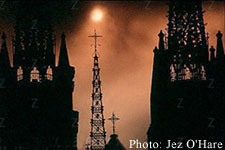
Wafat Isa Almasih - Good
Friday - Commemorates the death of Jesus
Hari Paskah - Easter - Celebrates the day
Jesus arose from the dead
Kenaikan Isa Almasih - Ascension of Christ- Commemorates the day Jesus ascended into Heaven
Hari Natal - Christmas - Celebrates the
birth of Jesus Christ
Hindu Holidays in Indonesia
Hari Raya Galungan - Galungan
Celebrates the coming of the Gods and the ancestral spirits to earth to dwell again in the homes of the descendants. The festivities are characterized by offerings, dances and new clothes. Learn more from this Video about Galungan/Kuningan.
Hari Raya Nyepi - Nyepi
Nyepi, or the Day of Silence, commemorates the start of the Hindu New Year, Nyepi is calculated according to the Çaka (Saka) lunar calendar and falls at the time of the new moon in the months of March or April each year, the first day of the month of Saka. The name Nyepi comes from the root word “sepi” meaning quiet or silent. Although it is a national holiday enjoyed by Indonesian residents throughout the country, Nyepi is celebrated in particular on the island of Bali where the majority of the 4.2 million inhabitants follow the Hindu religion, as well as in Balinese Hindu communities around Indonesia.
If you are in Bali in the days prior to Nyepi, you'll notice a lot of Melasti ceremonies at the beach, enjoy the processions and he noise on Nyepi eve, and a very quiet day stuck in your hotel, villa or home on the actual Day of Silence.
On the day before Nyepi major offerings are made to the demons at village crossroads, where evil spirits are believed to loiter. Before every ceremony a cleaning ceremony or mecaru must be held to drive out the devils and spiritually clean the place. On New Year's Eve the villages are cleaned, food is cooked for two days and in the evening the Ogoh-Ogoh paper mache statues which have been built by the local associations are paraded around the villages and battle each other on main roads and intersections. As much noise is made as possible through loud gamelan music, loud music and noise of the crowds to scare away the evil spirits from the village before the celebrants return home just before dawn.
On New Year's Day, all the island's inhabitants, Hindus or not, are not allowed to leave their homes, cook, used lights, listen to music, watch TV, or engage in any activity that makes any noise. It is believed that the evil spirits will be attracted to the noise/activity and enter the home. The island comes to a complete standstill from just before sunrise on New Year's Day until sunrise the following day. Streets are deserted - no cars, trucks, bicycles, motorcycles, street sellers, nothing! Tourists are not allowed to leave hotel complexes and can not take walks along the beach. Tourists will be sequestered along with supporting staff in the hotel.
Instead from your home or hotel room, you can enjoy the fresh air, quiet, and the sky will come alive with brilliant stars if the sky is clear, because all the lights on the island are turned off.
Devoted Balinese-Hindus observe four prohibitions for the 24 hour period, refraining from: work and other activities (amati karya); lighting fires or lamps (amati geni); venturing forth from their homes (amati Lelungan); and earthly pleasure (amati Lelanguan).
The international and domestic broadcast facilities in Bali are also shut down for 24 hours and all airports and ports are closed.
The religious rules, Catur Bratha Penyepian, encourage meditation, introspection and reflection during the period of observance and require:
- Amati gni – no open fires or flames
- Amati lelanguan – no pleasurable activities
- Amati karya – no work or labor
- Amati Lelungan – no journeys (except if someone is sick and needs medical care)
Community law enforcement officials go through the communities to make sure that these guidelines are being followed by all residents and visitors to the island for the length of the 24-hour period.
The local religious council also asks that people refrain from taking selfies with phone/camera during the day showing the deserted streets.
One fun aspect of Nyepi, is the omed-omedan Kissing Celebration that follows Nyepi, held by the the people living in Banjar Kaja Sesetan in downtown Denpasar!
Read more about The Celebration of Nyepi in Indonesia
 Buddhist Holidays in Indonesia
Hari Waisak - Waisak Day - Vesak - May
Commemorates the birth, enlightenment and death of Gautama Buddha. This celebration is enlivened by religious and social activities in Buddhist temples around the country. In Indonesia, the largest Buddhist temples, Candi Mendut and Candi Borobudur, both located in the Magelang Regency of Central Java not far from Yogyakarta, are the focus of interest and attract those observing the holiday and tourists.
Three major historical events are celebrated on Waisak. The first is the birth of Siddhartha Gautama. The second is the acceptance of the divine revelation under the Bodhi tree. And the third is the journey of Siddhartha Gautama to heaven. These three big events occur exactly on the Full Moon Purnama Sidhi. Thus, Waisak is also very well known as Tri Suci Waisak or Three Holy Events. Buddhists celebrate Waisak by praying to their God Sang Tri Ratna as thanks giving for creating and maintaining the earth and its resources in harmony. It is very common for Buddhists to celebrate Waisak with the presentation of fruit, flowers and candles. For Buddhists, candles symbolize their philosophy of life, the sought-after enlightenment. Provinces with a relatively high percentage of Buddhists are Jakarta, Riau, North Sumatra, and West Borneo. Two of the large Buddhist monasteries are located in North Jakarta (Sunter) and West Java (Pacet), where traditional celebrations can be witnessed.
Although only about 1% of Indonesia’s population is Buddhist the whole country joins in honoring this special day celebrated by Buddhists in Indonesia.
Every year at Waisak an impressive ceremony is held at Borobudur in Central Java. Borobudur is the second largest Buddhist temple in the world and an unequaled example of Buddhist architecture. It was built in the eighth or ninth century by the Shailendra dynasty and depicts the Buddhist cosmos. The monument is located on a hilltop and comprises a series of seven gray andesite stone terraces carved with narrative bas-reliefs depicting daily life, with rings of stupas enclosing statues of Buddha on the upper three levels and a massive closed stupa at the top. The Great Stupa stands 40 meters above the ground. Viewed from the air, Borobudur is laid out in the shape of a mandala, a Buddhist symbol used for meditation and prayer. The walk around each level of the Borobudur symbolizes a pilgrim’s gradual ascent toward pure knowledge and enlightenment. Since the monument was rediscovered (from the overgrowth in the forest) in the early 20th century it has undergone several restorations.
Nearby Mendut temple is an integral part of the Borobudur complex and is even older. It is located three kilometers from Borobudur and it is believed that pilgrims passed through this smaller temple complex before ascending the great Borobudur monument. Likewise at Waisak, a procession of approximately 25,000 Buddhist devotees commences at Mendut and proceeds slowly to Borobudur, the array of robes, banners, flowers, incense, colors and sounds providing a feast for all of the senses. Various sects or schools of Buddhism are united under the Council of Buddhist Communities (Walubi) that organizes the day’s events.
For the participants who gather to pay respect to Buddha, Waisak activities give strength to the spirit of all Buddhists. Buddha developed himself to achieve perfect mindfulness by dedicating himself to liberate all beings from suffering. Waisak reminds followers of Buddha to strive to become the best kind of human by sincerely and selflessly doing good deeds.
National Holidays
 August
17th, Hari Proklamasi Indonesia - Indonesian Independence Day
August
17th, Hari Proklamasi Indonesia - Indonesian Independence Day
Indonesians celebrate the proclamation of independence from 350 years of Dutch colonial rule. Festivities abound in cities and villages alike, organized by the government, neighborhood community associations and organizations. What's the 17th of August like in Jakarta?
International Holidays
January 1st, Tahun Baru - New Year's Day
New Year's Eve is celebrated with some revelry in urban areas. Hotels, discos and major restaurants offer special meals, entertainment and dancing. Partiers go to the streets and blow party horns and bang drums to welcome the new year.
January - February Imlek - Chinese New Year
The Lunar New Year is celebrated by Indonesians of Chinese ancestry. Visiting
of family and friends, special dishes  and
gifts of ampau (money) mark the day's activities. Chinese commercial districts in larger cities decorate with lanterns and banners and dragon dances
are held.
and
gifts of ampau (money) mark the day's activities. Chinese commercial districts in larger cities decorate with lanterns and banners and dragon dances
are held.
Most Chinese merchants close their shops for at least one day and maybe up to a week. Greeting cards can be sent to Chinese friends and colleagues; many are available in the stores. The date for Imlek is based on the Chinese lunar calendar. Government offices are open for business.
Commemorative Days
Offices and businesses do NOT close on commemorative days.
 April
21st Hari Kartini - Kartini Day
April
21st Hari Kartini - Kartini Day
The birthday of Raden Ajeng Kartini, a prominent leader in the women's emancipation movement in Indonesia. The event is marked by activities within women's groups. In Indonesian schools children compete in national dress competitions. The letters of Kartini to friends in Holland have been published in Letters of a Javanese Princess.
May 2nd Hari Pendidikan Nasional - National Education Day
Celebrates the birth, growth and progress in the Indonesian education system. Ceremonies are held at schools across the nation.
May 20th Hari Kebangkitan Nasional - National Awakening Day
June 1st Hari Pancasila - Pancasila Day
Commemorates the Indonesian State Philosophy, the five basic principles called Pancasila. Ceremonies are held at government offices and schools.
June 22nd Ulang Tahun Jakarta - Jakarta's Anniversary
Celebrates the founding of the city of Jakarta in 1527. The main event, the Jakarta Fair, is held at the Fairgrounds in Jakarta. In addition, performances highlighting Betawi (people indigenous to Jakarta) culture are held throughout the city.
September 30th G30S-PKI (pronounced gay tiga puluh es)
Commemorates the attempted overthrow of the Indonesian government by the Communist Party of Indonesia.
October 1st Hari Kesaktian Pancasila
October 5th Hari ABRI - Armed Forces Day
Commemorates the glories and achievements of the Indonesian Armed Forces, highlighting and reaffirming their unique role in Indonesian society.
October 28th Hari Sumpah Pemuda - Youth Pledge Day
Commemorates the uniting of the Indonesian youth against the Dutch and the pledge they developed on this day in 1928.
November 10th Hari Pahlawan - Hero's Day
Solemn ceremonies are held at national cemeteries around the archipelago. Those official designated as heroes by the Indonesian government are honored in a variety of forums and activities.
December 22nd Hari Ibu - Mother's Day
Events highlight the unique role of mothers specifically, and women in general.
Calendars Used in Indonesia
Muslim Calendar - Hijriah
A lunar calendar, 10-11 days shorter than the Gregorian calendar. The calendar begins in the year that Mohammad took flight from Mecca to Medina. Each lunar month has 29 days.
Gregorian or Roman Calendar
Used throughout the world, this calendar marks its beginning with the birth of Christ. The year is divided into 12 months, consisting of 30 or 31 days, except for the month of February.
Balinese Calendar - Saka-Wuku
The Balinese calendar, aka Pawukon calendar, is a combination of Saka, the Hindu solar-lunar year of 12 moons, and the Javanese-Balinese Wuku calendar of 210 days which is divided into weeks. The combination of these two calendars and the many names for the different weeks and days make the Balinese calendar a complicated puzzle to solve. Experts in the field consult special charts and tables to determine days for the various religious festivals and significant days.
The Balinese calendar is used to determine auspicious days such as Balinese New Year, birthdays (oton), anniversaries of temples (odalan), and the many festivals and religious days. It's also used for rites of passage events that are important in the everyday life of the Balinese - marriage, tooth filing, and cremations. Rural Balinese use the Saka-Wuku calendar to determine good days for the planting of crops. The calendar is determined by the phases of the moon, the most important days being each full moon (purnama) and new moon (tilem).
Mini Glossary
| Halal-bihalal | Gatherings held for the mutual begging of pardon |
| Hari libur | holiday |
| Ketupat | Traditional rice dish, cooked in coconut fronds |
| Mohon Maaf Lahir dan Batin | Traditional asking for forgiveness of slights and sins |
| Mudik | Mass exodus of Muslims from urban areas at Lebaran |
| Tanggal merah | Red date on calendars, a national holiday |
Last updated January 21, 2025