

Most Chinese festivals, whether based on seasons, myths about gods or ghosts, or a combination of these, stem from a belief in worshipping the gods to appease them and prevent misfortune. The biggest celebration is the beginning of the Chinese New Year.
Chinese New Year celebrations in Indonesia, known locally as Imlek, incorporate customs, beliefs and practices brought to Indonesia by Chinese immigrants who still follow the traditions handed down from their parents.
Chinese New Year, known as Imlek, has been a national public holiday in Indonesia since 2002 — a milestone that was welcomed by the country’s millions of ethnic Chinese citizens. The cultural liberalisation that made this possible continued into the following decade: in 2014, a Presidential Regulation formally revoked the Suharto-era Cabinet Instruction that had for decades restricted public expressions of Chinese culture in Indonesia.
Chinese New Year is a time to show respect for those that have passed away and to reunite with family members. Departed relatives are remembered with great respect because they were responsible for laying the foundations for the family’s fortune. Although customs may vary across the archipelago and even from family to family according to social position, many customs or versions of them are still observed by the ethnic Chinese community in Indonesia today.
Within the ethnic Chinese community there are immigrants from many regions throughout China. Distinctively different Chinese communities are found in Pontianak, for example, when compared to Medan or even Jakarta. Each of these immigrant communities brought the unique traditions of their hometowns to Indonesia. This diversity in origins explains the diversity in the way Chinese New Year is celebrated by communities throughout the Indonesian archipelago.
History of Chinese New Year
There are several theories as to the origins of Chinese New Year. The Chinese calendar is based on a combination of lunar and solar movements. Each lunar year is represented by one of 12 animals — a cycle also known as the Chinese Zodiac. The current Chinese lunar calendar was developed during the Tang dynasty (A.D. 618-907), with a lunar cycle of 29.5 days. The Chinese insert an extra month once every two to three years to compensate for the differences between the lunar and solar calendars, similar in principle to adding an extra day for leap year. This is why Chinese New Year falls on a different date each year.
Chinese New Year celebrations start with the New Moon on the first day of the year and end on the full moon 15 days later. It is also sometimes referred to as the Spring Festival or the “Beginning of Spring.” Although widely known as Chinese New Year, the Lunar New Year is celebrated by many communities across Asia beyond the Chinese diaspora.
The word “Nian,” meaning “year” in Chinese, is also the name of a monster from folklore said to prey on people the night before the New Year began. According to legend, Nian had a large mouth capable of swallowing people whole. Villagers across China lived in fear of the creature until one day an old man confronted Nian and persuaded him to prey on other beasts instead. The old man, who turned out to be an immortal god, instructed the villagers to hang red paper decorations on their windows and doors at the year’s end, since red was the colour Nian feared most. From then on, the tradition of marking the conquest of Nian carried on in Chinese communities around the world. Setting off firecrackers was also believed to frighten the creature away.
Although many ethnic Chinese in Indonesia may have forgotten the origins of these customs, the holiday is still celebrated with red decorations and, where permitted, firecrackers to add to the excitement.
Preparations for Chinese New Year
Preparations for Chinese New Year festivities in Indonesia begin well in advance of the actual date. As the year draws to a close, ethnic Chinese families tie up loose ends and put things in order in anticipation of beginning the New Year with a fresh start. Business people balance their books and settle debts that are owed.
Settling outstanding debts before New Year’s Eve remains an important tradition. It is considered deeply inappropriate to mention money owed on New Year’s Day itself, so these matters are resolved beforehand wherever possible. Beginning the year with a clean financial slate is seen as essential to inviting good fortune in the months ahead.
An important part of the preparations for the holiday is the thorough cleaning of the family home. This is important not only as preparation for the many guests who are expected during the holidays, but also because it is symbolic of sweeping away the evil spirits that might be lurking in dark corners or behind heavy pieces of furniture. The windows are washed, repainting is done, and in traditional homes the window frames and doors are painted red to prevent evil spirits from entering and to bring good fortune to the inhabitants.
All cleaning and sweeping must be completed before New Year’s Day, with brooms and brushes put away before dawn on the first day. Otherwise, the family believes they will face a year of bad luck and drudgery. Sweeping is not permitted on New Year’s Day itself, for fear that good fortune would be swept away with the dust.
In some very traditional families, sweeping is permitted from the second day of the New Year onward, but only toward the centre of the room. The collected dust must then be placed into the corners and not removed until the fifth day, when it can be taken out through the back door. Discarded in this way, no harm will befall the family.
Shopping is a major part of the pre-celebration preparations. Since New Year’s Day was historically a day of rest for everyone — including shop owners — all shopping had to be done before New Year’s Eve. In Indonesia, many shop owners still observe the holiday by closing for three or five days. The normally vibrant Chinese business districts in cities across Indonesia become noticeably quieter during the core holiday days, though the growth of modern retail and online shopping means this is less pronounced than it once was. Shop owners would never close for four days, as this number, when spoken aloud, sounds like the Chinese word for death — and therefore brings bad luck to the business.
Gift Giving
It is common to exchange gifts during the holiday season, and many ethnic Chinese families go on a buying spree in preparation for the gift exchange. The value and nature of a gift depends on the social standing of both the giver and the receiver. Costly or exotic foods, or a specially prepared dish with some symbolic meaning, are common choices.
Flowers are considered an auspicious gift, as they brighten the home of the recipient. The Chinese know that without flowers there would be no formation of fruit, so it is very important to have flowers and floral decorations in the home during the holiday season. Flowers are thought to be the emblems of the reawakening of nature, and are intimately connected with the wish for happiness in the year ahead. Blooming plants are also a symbol of rebirth and new growth. Small tangerine or orange trees symbolising abundant happiness, and white jonquils or narcissus, are favourite gifts within the Chinese community in Indonesia.
Paper decorations are bought and used to adorn the house. Pictures of ripe fruit or healthy smiling babies are common. Banners with gold Chinese lettering on bright red backgrounds are popular choices, typically pasted on either side of the front entrance with another banner above the door. The writing on the banners expresses wishes for good fortune, long life and many friends. Classically they are poetic in composition — common examples include “May you enjoy continuous good health” or “May the Star of Wealth, Star of Longevity, and Star of Happiness shine upon you.”
Chinese New Year greetings are sent to family members who live far away and are unable to join the traditional family gathering. While printed cards remain a cherished tradition in many households, digital greetings sent via WhatsApp and social media have become equally common among younger generations of Indonesian Chinese. The cards and messages are predominantly red, featuring images of the upcoming year’s zodiac animal, gold coins, cherry blossoms or fish — all objects associated with good luck and fortune.
According to tradition, families should wear new clothing during the festivities. Chinese believe that the appearance and attitude of a person on New Year’s Day sets the tone for the coming year. People often choose red clothing, a bright and happy colour believed to ensure a bright future for the wearer.
New Year’s Eve
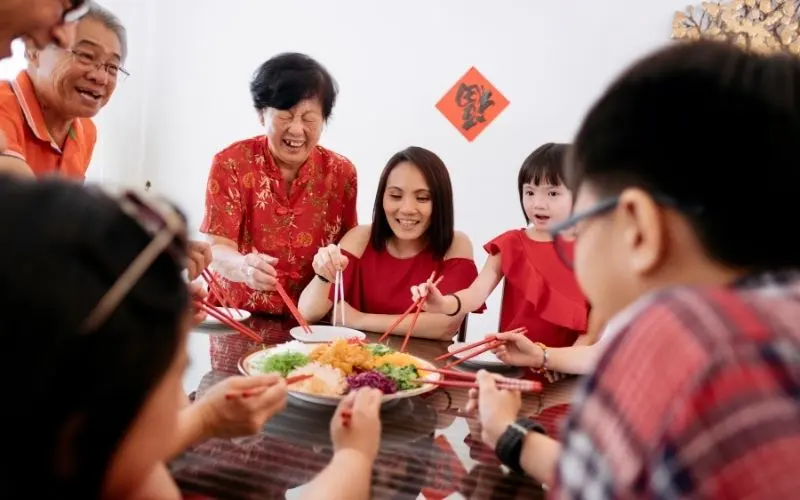
On New Year’s Eve, family members gather to observe the customs and share a traditional meal. Family members come from across town or across the Indonesian archipelago to welcome in the New Year together, usually at the home of the eldest family member.
According to custom, the male head of the family leads the household in making offerings to various house gods and family ancestors. Respect is paid to the god of wealth and the gods of the well, bed, hearth and other gods the family wishes to remain on good terms with. The offerings are usually a variety of foods, cakes and fruits placed on a table outside the house. While holding incense in both hands, each family member bows three times to show respect and honour for the house gods. The incense is then placed in a holder on the offering table and family members bow again to ask permission to enter the house.
An ancestral table is also set up inside the house if there is a family member who has passed away. A picture of the deceased is hung above the table. In wealthier homes, an entire room may be set aside as an ancestral hall complete with altar and tables for each generation, with small offerings placed throughout the year to honour departed family members. On New Year’s Eve, however, the table overflows with a beautiful display of food, flowers and the special dishes once enjoyed by the deceased during their lifetime.
Family members are expected to show respect to their ancestors by lighting incense and bowing in front of the offering table. It is considered even more respectful to kneel. Only after respect has been paid to the ancestors does the family continue with the evening’s festivities. Chinese around the world believe that the spirits of loved ones are present during the evening’s celebrations. When the ancestor worship rites are complete, the family gathers for the biggest meal of the year.
At midnight, candles burn in temples across the country as adherents believe that candlelight symbolises a bright future ahead. In the Jakarta area, one of the most atmospheric places to witness midnight prayers is Wihara Dharma Bhakti on Petak Sembilan in the Kota district — Jakarta’s historic Chinatown. Temples in Mangga Besar and Pluit also hold celebrations, as does Boen Tek Nio Temple in Tangerang. Visitors are welcome to observe respectfully, but it is advisable to check current event schedules directly with the temples, as programming can vary from year to year.
Significance of Traditional Foods
More food is consumed by Indonesian Chinese families during the New Year celebration than at any other holiday. As it is considered bad luck to cook on New Year’s Day itself, food is prepared the day before. Chinese believe that what you do on New Year’s Day will reflect on your life in the coming year, so most households prefer not to be tied to the kitchen on this auspicious morning. The large number of traditional dishes prepared is also meant to symbolise abundance and wealth for the household.
Most traditional dishes served on Chinese New Year are chosen for the significance of their name or appearance. One required dish is a whole fish. In Chinese, “fish” is “yu,” which sounds similar to the word for surplus or abundance. A whole fish must be served as this represents family togetherness. Oysters are also a favourite — in Cantonese, the word for oyster sounds like the word for “good business.” Shrimp is another regular on the New Year table, as the Cantonese pronunciation sounds like laughter. Clams are favoured because they open up when cooked, symbolising the opening of new horizons.
Indonesian Chinese whose ancestors came from Shanghai serve egg skin dumplings, which are thought to resemble gold ingots, while glass noodles are said to resemble silver chains. Bean sprouts are considered auspicious because they resemble a traditional art object called a “ruyi,” meaning “to your heart’s content” — a fitting symbol for the New Year. Black moss seaweed earns its place at the table because its name sounds similar to the phrase for “exceeding in wealth.” Lotus seeds are believed to bring many male offspring, which is highly prized in Chinese tradition. Chicken is considered a symbol of prosperity, though it should be presented whole — with the head, tail and feet intact — to symbolise completeness. Noodles are a necessity, but must be left uncut, as their length represents long life.

Ethnic Chinese with roots in northern China serve jiaozi, or meat-filled dumplings, whose name sounds like a phrase meaning “the meeting of the old year’s final hour with the new year’s first.” From southern China comes nian gao, a sweet rice pudding that is a cherished part of the New Year meal, along with zongzi — glutinous rice wrapped in reed leaves. Some families place stalks of sugar cane behind their doors, as the height and section-upon-section structure of the stalks represents the family’s hope for a ladder-like ascent to new heights in the coming year.
A candy tray is considered a necessity on the coffee table of any Chinese home for visiting family and guests. The tray is circular or octagonal in shape and is called the “Tray of Togetherness,” symbolising the family’s sweet start to the New Year. Every item on the tray is chosen for its symbolic meaning. Candied melon represents growth and good health. Melon seeds are dyed red to symbolise joy, happiness, truth and sincerity. Lychee nuts are thought to ensure strong family bonds. Kumquat represents prosperity, while coconut symbolises togetherness. Peanuts are associated with long life. Longan are believed to bring many sons, and lotus seeds many children. In very traditional families, after taking several pieces of candy from the tray, adults place an ang pau — a red envelope containing money — in the centre of the tray to wish good fortune to the household.
Just as certain foods are always served on New Year’s Eve, others are deliberately avoided. Tofu, for example, is never included in the New Year’s Eve meal. White is associated with death and misfortune in Chinese culture, and tofu’s colour makes it an unwelcome presence at the festive table.
After Dinner Festivities
After dinner, family members stay up late playing games, drinking, singing, joking and telling stories. Families strive to make the evening a happy one in hopes of setting the tone for the year ahead. Mahjong and card games are popular ways to pass the time before midnight. According to tradition, all the lights in the house must stay on throughout the evening — if the house is dark, the god of good fortune will not be able to find it and will pass by.
Some families spend part of the evening at the temple to light candles and pray to the gods, including Kwan Im, the goddess of love and mercy. In Indonesia, most temples hold midnight prayers during the New Year period, and hundreds of candles burn through the night. Congregants donate large candles — sometimes up to six feet tall — which continue to burn for several months after the ceremony.
At midnight, firecrackers are lit to add to the excitement of the occasion and, in keeping with tradition, to ward off evil spirits. In traditional families, every door and window in the house is opened to allow the old year to depart and good luck to enter with the New Year.
New Year’s Day
Most families wake early on New Year’s Day, as sleeping late is believed to make you lazy in the year ahead. Everyone makes an effort to look their best, wearing new clothes that are predominantly red. The first person one encounters and the first words heard on New Year’s Day are considered significant for what lies ahead. Children bow respectfully to their parents and offer the greeting “Gong Xi Fa Cai,” meaning “Wishing you prosperity.” Parents give their children ang pau — small red envelopes containing money. Ang pau is also given to the children of close relatives and to unmarried family members after they have offered New Year’s greetings to an elder. Once a person is married, they become a giver of ang pau rather than a recipient. It is considered unlucky to greet anyone in a bedroom, so everyone — even the unwell — should dress and sit in the living room.
Although everyone wants to look their best on New Year’s Day, washing your hair is considered unlucky, as doing so is believed to wash away good fortune. As a result, hair salons are extremely busy on New Year’s Eve, with some salons in Indonesia charging premium prices. Customers accept this as part of the tradition, and hairdressers also expect ang pau. In salons with a large Chinese Indonesian clientele, this practice can continue throughout the 15-day celebration period.
After greetings have been exchanged within the immediate family, families proceed to the home of the oldest family member. Traditional households may even consult a Chinese almanac to determine the most auspicious time to visit and the direction in which they should leave their home.
New Year’s Day is filled with family gatherings. While New Year’s Eve is typically reserved for the immediate family, New Year’s Day is the time to visit neighbours and more distant relatives. In Indonesia, this practice of visiting family and friends is more a sign of respect than a response to superstition. Most Chinese Indonesians spend the entire day driving across the city to pay their respects — a gesture that is highly valued within the community. If it is impossible to visit everyone in a single day, visits are acceptable at any point during the following 15 days.
When guests arrive during the New Year holiday, it is important to serve food or snacks that carry good fortune. Indonesian Chinese often serve kue lapis, a traditional layered cake, to visiting guests. The layers of the cake symbolise the ladder to achievement in the coming year. Many guests bring a gift of oranges or tangerines, sometimes with ang pau tucked inside the bag. Tangerines with their leaves still intact ensure that relationships with others will remain intact — and for newlyweds, this also symbolises the branching of the couple into a family with many children.
The ethnic Chinese community makes up approximately three to four percent of Indonesia’s population. For much of the New Order period under President Suharto, public expressions of Chinese culture — including New Year celebrations, Chinese-language signage and barongsai performances — were severely restricted under government policy. These restrictions began to ease following the fall of Suharto in 1998, and in 2002 Imlek was declared a national public holiday. A Presidential Regulation in 2014 formally revoked the original Cabinet Instruction that had underpinned decades of cultural suppression. Today, public Imlek celebrations are held openly across Indonesia, with shopping malls, public squares and cultural centres hosting events in major cities. Many families still prefer to observe the core rituals at home, in keeping with the holiday’s emphasis on family gathering, but the choice is now entirely their own.
Barongsai, the Lion Dance
Barongsai may be commonplace on New Year’s Day in other Asian countries, but in Indonesia performances are traditionally held at private homes or private parties. Barongsai is the Indonesian term for the traditional lion dance, performed by two dancers inside a colourful lion costume — one controlling the head and one the tail. A separate tradition, the dragon dance (known as Liong), involves a larger serpentine figure carried by multiple performers on poles. The two are related but distinct, and both may be seen during the New Year season. The dancer controlling the head of the Barongsai must be well versed in Kung Fu, as many of the steps in the dance closely resemble Kung Fu movements.
A barongsai troupe, consisting of at least ten people, will arrive by truck, and the accompanying orchestra can be heard long before the performers come into view. Drums, bells and cymbals provide the music for the dance. Families are happy to receive a barongsai visit because it is believed to bring good luck to the household. At the end of the performance, spectators place ang pau in the mouth of the lion in appreciation. Depending on the organisation backing the troupe, most of the money collected goes toward social and community work.
Today, barongsai performances are a familiar and celebrated part of the public Imlek season across Indonesia. Shopping malls, hotels and public spaces in Jakarta, Surabaya, Medan, Pontianak and other cities with significant Chinese Indonesian communities regularly host performances throughout the New Year period.
Chinese New Year Celebrations in Bali
Many of the ethnic Chinese community on the island visit local klenteng — Chinese temples — to burn incense and paper money, and to have their fortunes predicted for the year ahead. Bali’s Chinese Indonesian community, though smaller than those in Java or Kalimantan, maintains its own distinct temple traditions during Imlek. The Kuta and Denpasar areas have several active klenteng where visitors are welcome to observe ceremonies respectfully.
The Lantern Festival
The Lantern Festival on the 15th day of the New Year marks the end of the Chinese New Year celebrations. In the past, each family would construct a paper lantern to help light the way for the gods on this night. In many parts of China today, lanterns take on elaborate shapes and styles and are displayed in public exhibitions. The Lantern Festival is another occasion for inviting guests to the home for a large dinner. Although it is not on the same scale as the New Year’s celebration itself, it remains an important meal in the festive calendar.
After dinner, men traditionally parade outside carrying colourful paper lanterns, which have slips of paper with riddles written on them. Guests guess the answers to the riddles, and a drum is sounded when the correct answer is given.
While New Year’s customs vary throughout Chinese Indonesian communities across the archipelago, the spirit underlying the celebration of Imlek is the same everywhere: a sincere wish for peace, happiness and prosperity for family members and friends.
Hotels and restaurants in major Indonesian cities typically offer special Imlek-themed menus and promotions around the holiday season. Check listings closer to the date on local event guides and hotel websites directly for current offerings.
Frequently Asked Questions About Chinese New Year in Indonesia
Is Chinese New Year a public holiday in Indonesia?
Yes. Chinese New Year, known locally as Imlek, has been an official national public holiday in Indonesia since 2002. Banks, government offices and many businesses close on this day, and in cities with large ethnic Chinese populations the celebrations are visible and widely attended.
When is Chinese New Year in Indonesia?
The date changes each year because it is based on the lunar calendar, falling somewhere between late January and mid-February. In 2026, Chinese New Year falls on February 17.
What is Imlek?
Imlek is the Indonesian and Hokkien term for the Chinese Lunar New Year. The word comes from “Im” (lunar) and “Lek” (calendar). In Indonesia, the holiday is officially referred to as Tahun Baru Imlek.
What is ang pau and who gives it?
Ang pau (also written ang pao or hongbao) are small red envelopes containing money, given as gifts during the New Year period. In Indonesian Chinese tradition, ang pau is given by married adults to children and to unmarried younger family members. Once a person is married, they become a giver rather than a recipient.
What is barongsai?
Barongsai is the Indonesian term for the traditional lion dance performed during Chinese New Year. Two performers operate a colourful lion costume — one controlling the head and one the tail — to the accompaniment of drums, cymbals and gongs. The performance is believed to bring good luck to the household or venue being visited.
Where can I see Imlek celebrations in Jakarta?
Wihara Dharma Bhakti in Petak Sembilan in the Kota district is one of the oldest and most visited Chinese temples in Jakarta and hosts significant celebrations during Imlek. The surrounding Glodok area — Jakarta’s historic Chinatown — is particularly atmospheric during the New Year period. Shopping malls across the city also host barongsai performances and seasonal decorations.
Is it appropriate for non-Chinese Indonesians or expats to attend Imlek celebrations?
Yes. Public temple visits, barongsai performances and shopping mall events are generally open to everyone. If visiting a private home or attending a family gathering as a guest, wearing red or bringing a gift of oranges or tangerines is a respectful gesture. It is advisable to avoid wearing white or black, as these colours are associated with mourning in Chinese tradition.