
Home » Practical Information » Preparing Your New Home for Residence » Water
Bottled Water
Because the majority of ground water in Jakarta has been contaminated, it is highly advised to use purchase bottled water for drinking and cooking. Water that is supplied by PAM through the city water supply is most likely contaminated somewhere between the distillery and your home due to rusted pipes or broken water lines that have been repaired haphazardly. Even if your well/tap water looks clean - that doesn't mean it is. If you want to test the quality of the water in your home, you can have it tested at Laboratory Penguji Kualitas Air Minum located in the Benhill area for a very reasonable cost.
Dehydration in the Tropics
Because of the high temperatures in the tropics it is recommended that adults consume at least 8 full glass of water daily (about 1 1/2 liters) due to the higher temperatures, humidity, This will help your body cope with overheating. Dehydration is a serious concern. If you are not used to a tropical climate, undertake strenuous exercise with care. A packet of Oralit/Pharlolit stirred into a small glass of bottled water will easily replace fluids lost to sweat or extensive exposure to the sun. These packets are easy to purchase at the drug store (apotik) and cost a lot less than bottled rehydration fluids.
Water Delivery Service
You can set up a delivery service for water to your residence, office
or factory. Bottled water comes in single serving glasses, one or two-liter
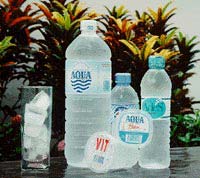
bottles and 5-gallon bottles. Try out the smaller bottles from the supermarket first
to determine which brand you prefer as different brands have distinctively different tastes. Call the agent that delivers the water that you prefer and set up a regularly scheduled delivery service. Water is usually
delivered once a week, accompanied by antiseptic wipes which are used
to clean the openings to the bottles. Upon delivery, be sure that the
plastic safety seal is still on the bottle and has not been tampered with. If it's been tampered with, do not accept delivery of that bottle.
first
to determine which brand you prefer as different brands have distinctively different tastes. Call the agent that delivers the water that you prefer and set up a regularly scheduled delivery service. Water is usually
delivered once a week, accompanied by antiseptic wipes which are used
to clean the openings to the bottles. Upon delivery, be sure that the
plastic safety seal is still on the bottle and has not been tampered with. If it's been tampered with, do not accept delivery of that bottle.
An alternate to a delivery service is to buy 5-gallon bottles through your local grocery store. The bottles may be cleaner on the outside (less dust and dirt), though you still have to use antiseptic wipes provided to sanitize the opening of the bottle before they are inverted into your water dispenser. Supervise your household staff if they are responsible for switching out the water bottles in your dispenser. They may not understand the importance of thoroughly wiping the top of the bottle and may need some explanation and demonstration on how to correctly wipe and replace the bottle. Normally, you spend a little more on your first bottle since you are also paying for the bottle deposit.
Once you have empty bottles you can exchange them for a refilled bottle and you only pay for the water, not the bottle deposit. At most supermarkets or Hypermarts, ask for bottled water, exchange your empty bottle, and then bring the new bottle to the cashier for payment. The cashier will ask you whether you are just paying for the contents (the water) or you are paying for the water and the bottle deposit. The cashier will usually give you antiseptic wipes; if they don't, ask for some. Many neighborhoods also have a warung or small food stall that sells bottled water. You will need to trade in your empty bottle or pay a deposit for the new bottle.
 Be cautious of bottle refilling stations! We have heard stories
of household helpers or drivers who wanted to earn some pocket money and they
go to the non-potable water refilling stations with empty branded gallon
bottles, to fill the bottle there. The water is of an inferior quality, most likely doesn't pass the standards for drinking
water, and
may be contaminated with e-coli and other parasites/bacteria. To be certain of the quality of the water, it is better to order
delivery direct from a well known bottled water supplier.
Be cautious of bottle refilling stations! We have heard stories
of household helpers or drivers who wanted to earn some pocket money and they
go to the non-potable water refilling stations with empty branded gallon
bottles, to fill the bottle there. The water is of an inferior quality, most likely doesn't pass the standards for drinking
water, and
may be contaminated with e-coli and other parasites/bacteria. To be certain of the quality of the water, it is better to order
delivery direct from a well known bottled water supplier.
Payment for your weekly water delivery is usually made once a month to a person other than the delivery men. They will present an itemized bill, together with copies of the signed delivery receipts from the previous month.
Ask your delivery men how many weeks they'll be off for the Lebaran holidays, so you can stock up ahead of time for that 2-3 week period when you may not be receiving any water deliveries. It is also advisable to give your water delivery men a 'tip' before Lebaran. This small token for their good service will be much appreciated.
For those who are concerned about the ever growing problems with plastic waste or those who are trying to achieve Zero Waste in their household, the delivery of the 5 gallon bottles to your house makes a lot of sense! Use that water to refill reusable stainless water bottles and benefit the environment and your wallet at the same time!
 Water Dispensers
There are a variety of dispensers you can purchase or rent from your water supplier or purchase from a department store. Some are ceramic and have only one spigot for room temperature water. Others are electric and have two spigots - one for hot water and one for cold water. Before inverting the bottle into your dispenser, or inserting into the bottom of the appliance, clean the top of bottle thoroughly, using an anti-bacterial cleansing wipe around the top of the bottle.
If you have been away on holiday, be sure to rinse out any water that might have been stagnant in the dispenser and replace the bottle with a freshly opened bottle. Even under constant use, be sure to cleanse your dispenser occasionally with a diluted solution of bleach or sterilizing solution to ensure that bacteria isn't building up within the dispenser.
If you have small children, the older type of hot/cold water dispenser that has not been fitted with a safety lock may pose a safety hazard for your small children. Make sure that they can not reach the tap and potentially be scalded by the hot water.
See also:
Household Water Supply and Treatment Systems
Gastroenteritis and Food/Water Borne Diseases
Last updated April 4, 2019