

Karo Batak Wedding Ceremonies: Understanding the Meaning Behind the Rituals
For foreigners living in Indonesia, being invited to witness Karo Batak Wedding Ceremonies offers a rare look into the deeper structure of traditional Indonesian family life. A Karo Batak wedding, rooted in the customs of the Karo people of North Sumatra, is not simply a celebration between two individuals. It is a formal cultural process that connects two extended families, defines social roles, and honors ancestral traditions.
The Batak people consist of several distinct groups, including Karo, Toba, Simalungun, Pakpak/Dairi, Mandailing, Angkola, and others. While these groups share historical links, each has its own language, customs, and wedding traditions. The Karo homeland is centered around the Karo Highlands near Medan and Berastagi, an area known for its strong cultural identity.
In Karo Batak Wedding Ceremonies, every ritual has meaning. Family relationships are carefully recognized, responsibilities are clarified, and the marriage becomes a public acknowledgment of unity between two family networks. For expats, understanding these traditions helps explain why Indonesian weddings often involve not only the bride and groom, but the wider family and community as well.
Note for expats: Traditions vary by family, church/denomination, and region. Even within Karo communities, the sequence and emphasis of rituals can differ—so treat any “step-by-step” guide as a helpful map, not a fixed script.
The Big Idea Behind Karo Batak Wedding Ceremonies
The central idea behind Karo Batak Wedding Ceremonies is that marriage is not only a personal event between the bride and groom. In Karo culture, marriage is also a formal agreement between families, clans, and kinship groups.
Karo society places strong importance on family identity and social roles. One key concept is Rakut Sitelu, which refers to three main relationship groups: kalimbubu, senina/sembuyak, and anak beru. You may also hear the broader term Tutur Siwaluh, which describes eight kinship categories used to understand how people are connected to one another.
This is why Karo Batak Wedding Ceremonies can feel highly structured. There are assigned speakers, specific seating arrangements, and clear ritual responsibilities. Every part of the ceremony helps show who belongs to which family role, who gives respect, and who receives it. For foreigners, this structure may feel formal at first, but it reflects the deep importance of family order, respect, and social harmony in Karo culture.
“You must become Karo”: clan identity and how outsiders can be included
Older explanations sometimes summarize the rule as “a Batak can only marry another Batak.” In real life, what matters is adat legitimacy—whether the groom and bride are correctly placed into the kinship system so the marriage can be recognized by both families.
For Karo people, identity is closely linked to Merga Silima (the five main Karo clan groups): Karo-karo, Ginting, Tarigan, Sembiring, and Perangin-angin, each with many sub-clans. Because the kinship system and marriage rules depend on merga (clan), a non-Karo groom may be ritually adopted into a Karo clan line so that the wedding can proceed in a way that “makes sense” within adat.
In the original story shared here, the groom was accepted into a Karo clan through family agreement and a ceremonial exchange of symbolic gifts (including a Karo textile). This kind of adoption is best understood as social and ceremonial integration—a way to give the groom a recognized position and obligations in the wider family system.
Key kinship roles you may hear during the negotiations
During Karo wedding discussions, you may hear terms like:
- Kalimbubu: the “wife-giving” side, highly respected; often described as a source of blessing and guidance.
- Sembuyak/Senina: “same-side” relatives, often those who stand with and support the core family group.
- Anak beru: the “wife-receiving” side who commonly takes on practical responsibilities for making the event run smoothly.
- Puang kalimbubu: an even more senior respect position (“kalimbubu of the kalimbubu”), depending on the relationship mapping.
For foreigners, the important takeaway is not memorizing the vocabulary—it’s recognizing that speaking order, seating, and who delivers advice are tied to these roles, and are taken seriously.
Requesting the Bride’s Hand in Karo Batak Wedding Ceremonies
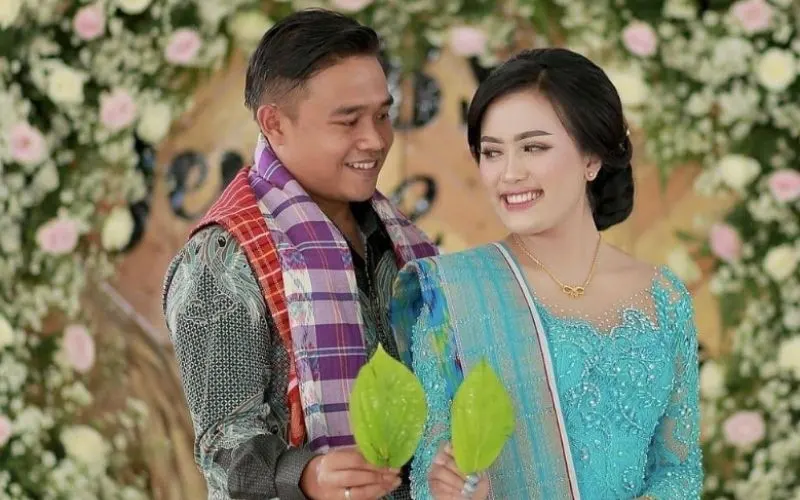
A classic pre-wedding stage in Karo Batak Wedding Ceremonies is the formal proposal meeting, known as Mbaba or Ngembah Belo Selambar, which literally refers to “bringing a sirih leaf.” This is the moment when both families meet to discuss the couple’s intention to marry and begin arranging the practical details of the wedding.
During this stage, the families may discuss important matters such as the ceremony format, family roles, adat obligations, and customary gifts or payments that symbolize the joining of two family groups.

Another important step is Nganting Manuk, often translated as “bringing a chicken.” Traditionally, this involved bringing a chicken to the bride’s home. Today, it is often accompanied by a meal and functions as part of fulfilling the agreed adat contributions.
You may also see a gift basket used early in the meeting, commonly filled with betel-chew items or refreshments. This gesture helps open the conversation, show goodwill, and create a respectful atmosphere before more serious family negotiations begin.
Religion and legal registration: what still matters in 2026
Many Karo families are Christian, and it’s common to have both an adat sequence and a church blessing. However, regardless of religion, expats should understand a basic Indonesia-wide rule: a marriage must be registered with the state to be legally recognized.
For non-Muslim marriages, guidance commonly states that after the religious ceremony, the marriage should be recorded with the Civil Registry / Dukcapil (Population and Civil Registration Office). (For Muslim marriages, registration is handled through the Office of Religious Affairs/KUA—this is mentioned widely in legal analyses of Indonesian marriage registration. )
Expat-friendly tip: Requirements can vary by region and individual circumstances (mixed nationality, documents, religion). If you are personally involved, confirm the checklist with the local registry office before setting dates.
The Karo Batak Wedding Ceremonies reception: “Kerja Adat” and the landek dance
The main celebration is often described as a big party—sometimes referred to as kerja adat in Karo contexts—and it can be energetic, communal, and deeply symbolic. Academic and cultural sources frequently reference landek as the signature dance performed during Karo ceremonial events.
The procession and seating
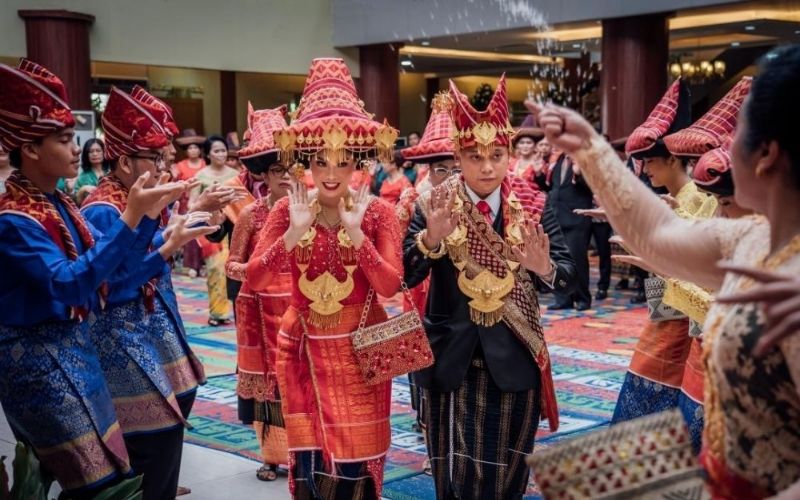
In many Karo receptions, the couple enters with family in a procession. Families may sit facing each other, and in some venues you’ll still see mats (tikar) used rather than chairs, especially in more traditional settings. Don’t assume “mats” means informal—the seating can be highly structured.
Advice and speeches
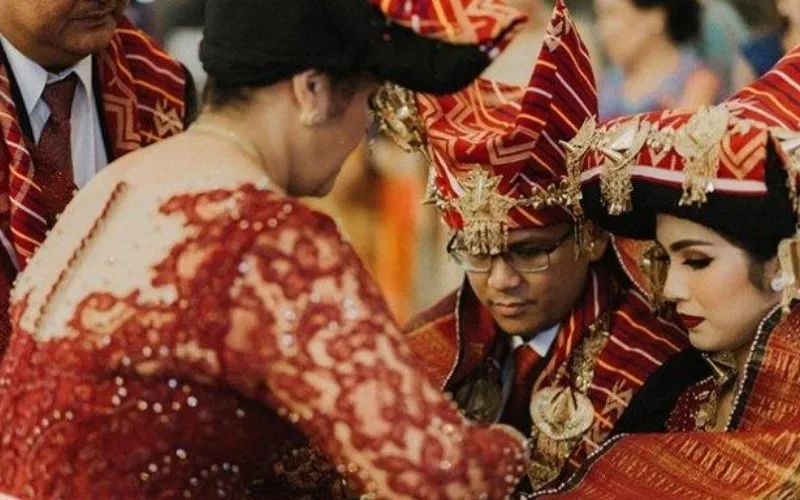
Speeches commonly follow a customary order, with advice offered to the couple and acknowledgments exchanged between family groups. In modern city weddings, you may hear multiple languages depending on the families and guests.
Giving gifts
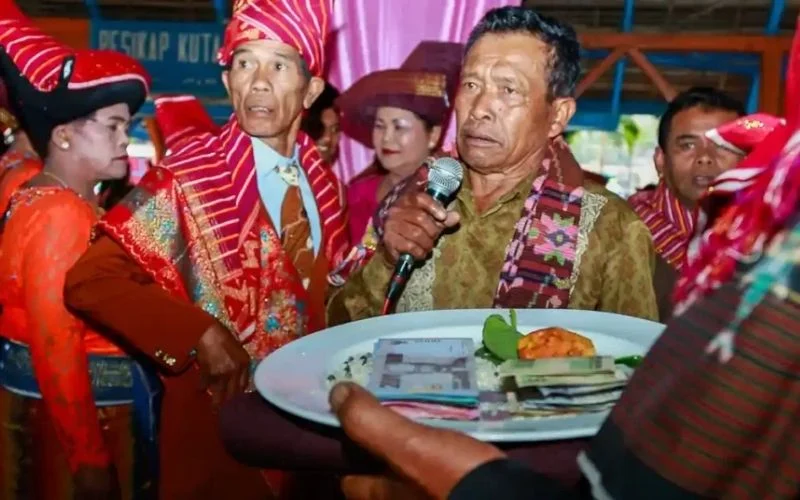
You may see guests place money into a basket as a practical wedding gift. This is widely understood today as a modern cash-gifting habit rather than a strict adat obligation, but it is common enough that foreigners should not be surprised.
Traditional textiles and dress: uis nipes/uis nipis and ceremonial accessories
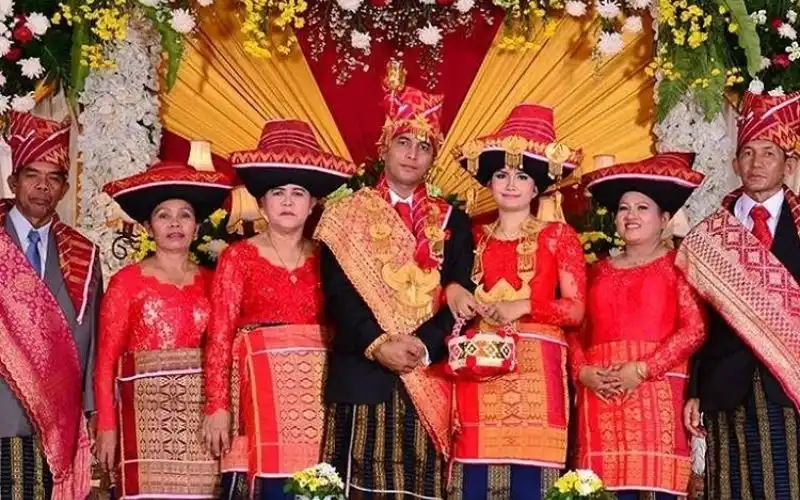
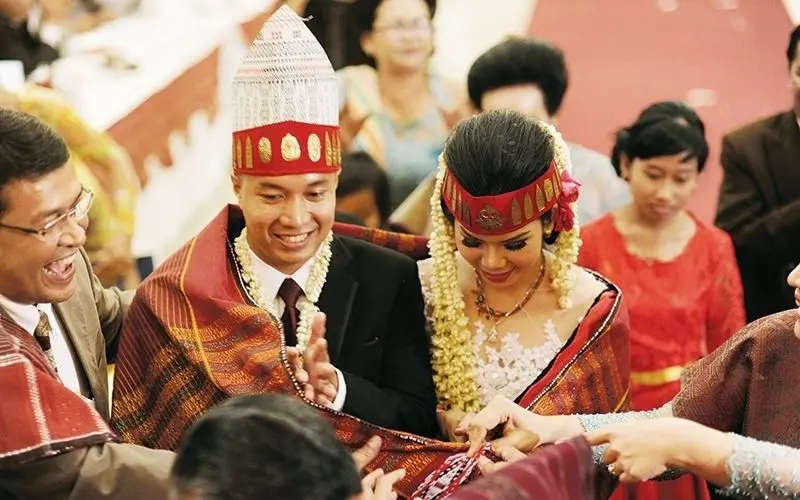
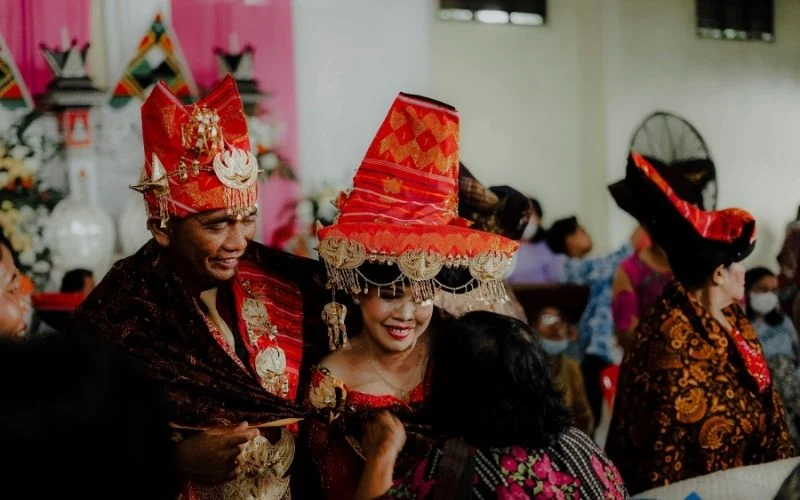
Karo ceremonial clothing is rich with textiles and gold-colored accessories. Karo textiles are commonly referred to as uis nipes/uis nipis (spelling varies in English/Indonesian writing), and they function as identity markers and status symbols used in major life-cycle ceremonies, including weddings.
Some sources and community references describe different named cloth pieces depending on how they’re worn (for example, a cloth over the shoulder vs. wrapped at the waist). Because terminology can vary by region and family, it’s safest to treat specific cloth names as family-specific unless you confirm them locally.
A bride’s headdress and the groom’s headwear are important visual symbols, and many families use heirloom jewelry where possible; modern couples sometimes choose lighter, plated versions for comfort.
A tradition you may hear about: “four days” and post-wedding rites
Older accounts sometimes describe a requirement that the couple stays at the groom’s family home for four days and nights after the reception. Contemporary sources describing Karo post-wedding rites often reference a ceremony occurring after four days, such as ngulihi tudung/ngulihi bulang being held after the completion event (mukul).
Practical takeaway: The “four days” idea exists in Karo wedding narratives, but what it means (strict confinement vs. timing of follow-up ceremonies/visits) can vary by family and modern living realities. If you are attending or documenting a wedding, ask a close family member how their family interprets this today.
What expats should do at a Karo wedding (simple etiquette)
Dress respectfully. If the invitation specifies traditional attire, ask what is appropriate—some hosts are delighted to help foreigners participate correctly. Arrive on time for church blessings and formal adat moments, but note that receptions in Indonesia often have a flexible arrival window unless the family tells you otherwise.
During speeches and ritual moments, observe first and follow the lead of your host. If you are invited to join the landek dance, it’s usually more about participation and respect than “dance skill.” If you give a gift, cash in an envelope is widely understood in Indonesia, but your host can tell you what is customary for their family.