
Home » Practical Information » Expat Living Outside Jakarta
Expat Living in Manado, North Sulawesi
The people make the town seem like that. The people of Manado are interesting - generations of immigrants mixed with the Manadonese - Dutch, Chinese, Japanese, Portuguese, Indian, and many others, making the local population very special indeed. Additional influence comes from the not-far-away Philippines. Many of the Minahasan people have Dutch first names and many also have a Dutch last name. In some ways, the Manadonese look more Latino than East Asian with dark skin, curly hair, brown eyes and choleric characteristics. But they are also an easy-going, emotional, sympathetic, and happy people.
Manado is predominantly Christian, with Protestant being the majority and a sizeable number of Catholic, Adventist, Pentecostals, and other Christian denominations. In fact, Manado is definitively the city of Indonesia with the most churches per inhabitants and would certainly rank in the top ten on a world chart. In a 1km radius of you could have at least 20 churches, but two mosques. The remaining 20% of the population are Muslim.
The population is approximately 459,000 (2023).
Lifestyles of the Locals
Manado is a relatively well-to-do town. Not in the western way of thinking, even far from the standards of Jakarta, but still well to do. The fortunes come from the old coconut, vanilla and clove plantations. But also from rich fishing resources, mining, as well as trade with Central Sulawesi, the Sanghie Islands (a get away for Filipinos) and the Moluccas.
The economic elite are primarily of Chinese origin, just like in many other Asian countries. The only difference with the local Chinese community is that in Manado there are not many racial tensions. All of the communities are quite well integrated. Multiracial families (Chinese and Manadonese) are quite common.
Manado has a good mix of ethnic groups from Eastern Indonesia. There are quite a few residents from Gorontalo, Sangihe, Maluku, and Papua who have settled in Manado and are well integrated for many years now.
You ask why I think Manado is funny. Well, Manado is funny because here it seems as if time stopped fifty years ago. Business is still based not on contracts but on hand shakes. The bureaucracy is easy bypassed with good personal relations and problems are managed through old respected family chiefs.
Cars, equipment, machinery and banking affairs are more expensive
(10% to 15 %) than in Jakarta or Surabaya, but nobody cares. More important
to the locals is that coconut oil, rice, fish and chili peppers are not
expensive, but 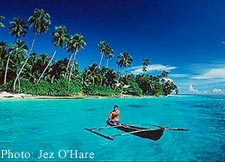 are
easy to find and buy.
are
easy to find and buy.
As soon as a little money is in the pocket of most Manadonese, you can be sure that the money will run out in one day. He or she, will run to one of the newly erected shopping malls on the front sea, such as Mantos or Mega Mall and buy whatever attracts his or her attention. Or if there is a bit more money, it will be spent in restaurants, (there are many), discos, and other forms of nightlife.
The Manadonese guide their lives by stories they hear of the lifestyles in Singapore and Jakarta. Fashions come here a couple of years later than in the rest of the world.
Most middle class people live in town, or live within 5-10 kilometres of the town of Manado. Poorer people live around the river that divides the town in two. Nicer neighborhoods are up in the hills, where the politicians and government officials live.
Most of the middle and upper class Manadonese have relatives in the villages near the plantations. The plantation-based relatives hold most of the family wealth and all Manadonese, from time to time, have to visit their relative's village for money refueling.
Expat Community
The expatriate community in Manado is not big, perhaps only 50-60 persons; but occasionally you will meet a an expat who has lived in Manado for years. Some expats are in Manado because of tourism-related businesses, like diving. Others are in the hotel business, as Hotel Managers. Still others are in mining, based in Manado, but working in the jungle camps.
The rest of the expatriate community, working in different sectors as well as a number of retired expatriates who are married to Indonesian women. The community consists of a pretty even mix of expats who are Dutch, English, Japanese, Italian, American, French, Swiss, Chinese, Philipino, Canadian, Indian, German, Korean, and Singaporean.
Recreation
There are only a few cultural activities in Manado. There are two cinemas, one being in Mantos and the second at the entrance of Kampung Cina, no theatres and no concert hall. Most of the activities are organised by churches, so it is quite common to attend a Gospel service on Sunday mornings. More common entertainment for locals are car races and animal fights. One of the best activites in Manado is what the locals call “carlotta” which means to talk and talk about each other.
Expatriates spend much of their free time on the weekends diving or fishing iin Manado, Bunaken and Selat Lembeh. The diving is really fantastic, one of the best places to dive in the world. There is a karting circuit and a few other sports to do. Golf is also a common activity. Tennis, jogging, cycling, and climbing the volcanic mountains are also popular. There are tennis courts, but don't expect top quality surfaces.
Night life options are limited. There are Karaoke bars, restaurants, a few night clubs, a few hotel venues, and a couple of discos. Groups of Italian or German tourists can often be seen accompanied by their local guides on a tour of the various night life spots. The Aha Café” (upper floor of Mega mall) and “Corner Café”in Bahu, and Cabal in Kawasan Megamas are popular. There is also a bowling alley and a huge billiards café on the upper floors of Mega Mall, which is quite a popular place for Manadonese students.
Yahama Music School, on Jalan Sam Ratulangi in the city center, offers a variety of music lessons for children and adults.
Most hotel fitness rooms and pools are open to non guests for a fee. They also offer memberships with monthly or yearly fee. Check out the facilities at Sintesa Peninsula and Manado Tateli Beach Resort.
Housing
Many expatriates live near the airport, were the golf club is. The airport residential area is about 20 kilometres from town, which is 20 to 30 minutes by car because of the heavy traffic. Expatriates who have lived in Manado longer tend to live in town.
Housing costs are cheap and houses are quite easy to rent. A villa with a garden in the residential area in the hills near the city, with 4/5 rooms, AC and two bathrooms can be rented for a reasonable price. Usually the landlord requests two years rent in advance.
Do not count on buying land. Land prices are not expensive, but it takes a long time to build a house, longer than anyone would expect. Problems with the legal ownership of land and houses by exptriates prevents most from making that investment.
You will not find websites featuring online ads concerning housing in Manado. There is no real market for it since most of the houses are rented out through word of mouth. There are a couple of established real estate agents in Manado. One of them is Era Mega, a well known real estate broker. While these agents may be able to assist newcomers in finding a residence, their English may be limited. It is advisable to ask the company that will employ you if they have any leads on housing.
CitraLand offers you some of the best housing in Manado. It is a modern estate which tries to look like an US estate with large streets and a lot of green space; it's just a bit outside the city but still about 15 minutes by car from Tanjung Batu. Also it is connected to the bypass road, which means that it wouldn't be more than 30 minutes away from the Medan International School. The city center, where the malls are, would be 20 minutes from CitraLand. They are also building shops in CitraLand as well. There is a water park for the kids and plenty of places to bike and play for the kids.
Some other new residential areas are being built in various locations, a bit outside Manado. None beat Citraland, but they could be an alternatives to consider. Batukota and Winangun are half way in between the city center and CitraLand. A little bit uphill there are also two districts to consider, with a few nice houses in a green surrounding.
Utilities
Electricity (PLN) and water (PDAM) have unreliable service. There is a shortage of power in Manado and its surrounding area, just as in many cities in Indonesia. This results in power cuts from time to time; it is not rare to have periods with a power cut of about 1 hour a day. This is especially true when one's house is located outside Manado in a not so busy district. Also, when you will have found a house, make sure that it has a very minimum of 2200 W if there is no air conditioning and a very minimum of 5000 W if there is. Houses with as low as 900 W or 1300 W are not rare. But, if you want to plug a microwave, better to unplug first the TV. It is not something you want to have to live through!
PDAM, the water company is improving, but there are still often shortages. You will have to make sure that your house has a well with a working pump giving enough pressure for the whole house. Check the tap at the upper level of the house for the pressure. Also, a house with a water tower and a tank of at least 2000L wouldn't be a bad idea.
Indovision Cable is available in Manado, which provides packages where one can watch ESPN, Star Sports, HBO, CNN, National Geographic, Cartoon Network, and the like. It costs over IDR 400.000 (USD 45) a month. You can also have a satellite dish and a receiver with no monthly payment and where you can receive around 250 channels from around the world (though mostly Asia). On this system you can get TV5 (French), RAI (Italian) along with a German, a Portuguese and a Spanish channel.
Internet. You can get wired with Speedy. It's OK, though the speed is nothing to compare with European or US internet connection speeds. At least it's broadband. It costs around IDR 200.000 for 50 hours and a minimal fee per hour for extra hours or IDR 700.000 for unlimited access.
All Indonesian cell phone carriers are present in Manado. Any cell phone, as long as it is unlocked, would receive a card from any these local carriers.
Shopping
Imported food products are available at Gelael (basement of Megamall) but they are, of course, expensive. Other supermarket have a limited selection of imported goods: Golden and Hypermart. Golden is globally the cheapest supermarket in town and it is the place you should look for when it comes to your general food shopping. Hypermart has three outlets in town (Lippomall, Mantos and MTC) but is pretty expensive for many items. Carrefour has plans to open at least one outlet (Mantos 3) in late 2015 early 2016.
Schooling
Manado International School
Parkville Estate
Parklane Kav. B1-4
Jalan Walanda Maramis
Kalawat, Manado,
Tel. (+62 431) 892-252
Fax (+62 431) 892-678
Website mis-mdo.sch.id
Citra Kasih National SPK School
Kindergarten and Elementary levels only
Singapore curriculum
Citra Kasih National Plus School is situated at the entrance of Citraland, on the way to Tomohon.
Medical Care
Manado. Doctors are of fair quality, however it is recommended to travel to Jakarta for any surgery (3-hour flight, several times a day, many domestic airlines). There are several local pediatricians, good dentists and countless pharmacies in Manado for routine care.
Transportation
Inside the city, taxis are everywhere. You can phone the taxi companies and ask them to pick you up at your house. However, you should give them a detailed explanation in Bahasa Indonesia, if you really want them to show up. Very few people speak english in Manado, and certainly not the taxi drivers. They will however make an effort to greet you in English with a smile and a loud "hello miss" even if you are a "mister". You'll get used to it. May be difficult to get a taxi driver to drive you to destinations outside the town of Manado, as they are not sure of getting a passenger coming back into town.
Also, make sure, as much as possible, to know the road to travel before you set out with a taxi driver. DO NOT expect the taxi driver to know the way to go there if you give him only the address with the street name (if there is a street name!). Being able to name the nearest church, however will help. Most people will tell you that they leave near church X for you to situate it. Churches are the only reliable landmarks.
Cars in Manado are slightly more expensive than in Jakarta, by about 10 to 15%.
Toyota Avanza and Daihatsu Xenia go for IDR 160 millions (a bit less than USD 18.000).
Toyota Innova are about 230 millions (or 240?).
Nissan livina go for a bit less than 200 million.
Mitsubishi Triton and Toyota Fortuner go for a little over 400 million and Mitusbishi Pajero go for about 480 million.
Toyota Yaris go for 200 million and Honda Jazz are about 220 million (6/2010 prices).
Second hand cars are available BUT are usually a rip off: bad maintenance and at a price very close to the retail price of new cars.
There is not much public transportation other than the Kota buses and and mikrolets (small 9 seat public transportation). Cars are easy to rent and not too expensive. At the local market it is possible to rent a Kijang for Rp 100,000/day (including fuel) or for Rp 2 million/month. A Toyota Avanza can be rented for about IDR 250.000/day without driver and fuel not included. Add IDR 50.000 for a driver. An Innova cost about IDR 300.000/day. On a monthly basis count on IDR 5.000.000 for an Avanza and IDR 6.000.000 for a Toyota Innova (June 2010 prices).
Many expats enjoy living in Manado as life is much simpler that Jakarta's big metrolpolis. Manado may not have a lot of facilities, but the area is really nice. The islands surrounding the area are really a tropical island paradise, with beautiful white beaches. Only one hour away from Manado, but really a different world.
Our thanks to Fabrizio Ratti for sharing his personal insights into Expat Living in Manado for the original article, and to Jeremy and & Ninny Barnes of Safari Tours and Travel and Oliver Rula for their additions/revisions to the article!