
Home » Practical Information » Expat Stories
A Kitemaker's Guide to the Archipelago
by Neil Taylor
September 20th, 1975
It was my first trip outside of England and Australia. I arrived at the tin shed called Kupang airport, Timor with one other passenger off the Fokker Friendship out of Darwin. I had actually bought a ticket to Dili in Portuguese Timor before hitch-hiking to Darwin from Melbourne.
In the mean time the Australian Government had banned all flights there due to their apparent expectation of yet another third world rebel skirmish. For the first time in my life I was faced with a surprisingly short race of people who didn't understand a word I said. It was odd - they all kept smiling at me.
A friendly chap from a losmen called Fatule'o took me into town and guided me to a small, neat shared room. Pretty good value at Rp 200 (40c) a night. I strolled into town. Every single person I passed smiled a “hello mister” at me.
A group of about 20 children joined me as I walked. They laughed and skipped along and took turns holding my hands. Why is everyone so bloody happy here?! I had been one hour in this strange country and already I felt more relaxed than I did at home.
My first restaurant meal was like a new game. I point at food in the glass case, owner smiles and says something unintelligible, I nod and smile back, food is served. Mmm ... gado-gado. Tasted good, yetI hate salad!
Later on, I settled into another café by the harbour and enjoyed my first ever bottle of Bintang beer. A couple of friendly young guys joined me and we played the inevitable word game. Kaki, tangan, kepala, kelapa ...kepala-kelapa! I'll never forget cucu dinding (“train”- surely!) and terima kasih - “tear out my car seat”!
Twenty years later I still find myself explaining to my Aussie friends the difference between the people in Indonesia and the authorities in Jakarta. Over the following days I began to get used to actually holding hands with these two, after all, everyone else held hands, even the soldiers!
 Several
days later I took the only boat (a loose term meaning something that still
floats) out of Kupang to Ende in Flores. What a rusting heap was the “Bintang
16”. Everything I touched had a thin coating of oil on it. I settled in
on top of the wheel house along with a small group of local students and
a newly arrived fellow backpacker. I made sure that I was the closest to
the only visible lifeboat!
Several
days later I took the only boat (a loose term meaning something that still
floats) out of Kupang to Ende in Flores. What a rusting heap was the “Bintang
16”. Everything I touched had a thin coating of oil on it. I settled in
on top of the wheel house along with a small group of local students and
a newly arrived fellow backpacker. I made sure that I was the closest to
the only visible lifeboat!
My new companion Ray had arrived at Kupang airport without a health card. Ten dollars had solved the problem instantly! He'd been working on a station in the bush and was keen to see a bit of Indonesia. I learned more Bahasa Indonesia that night than I could have done in any classroom. It was a calm moonlit night broken only by our laughs and the chugging of the aging diesel engine far below. This was Paradise, how could we sleep!
The daylight brought intense heat with little shade. We took turns in standing on a narrow platform surrounding the boat's thrashing screw. Every few seconds the rear of the boat dropped several feet in the swell and cooled our sweating bodies. The crew then delighted in pouring a bucket of fresh water over our heads to clean off the salt water.
Arriving in Ende, I wondered if the boat would survive its next trip. So this is Flores, island number 2, only 17,000 odd to go! Ende with it's volcanic backdrop felt a lot more Islamic than Kupang had. Still the smiling faces but more “topi” and “haji” than I had seen before.
I wanted to go inland to climb Mt. Keli-mutu and see its three coloured
crater lakes. We took a bemo to Mone, about
2 hours drive along a very rough dirt road, followed by a few hours steady
uphill walk to the top. What a magnificent sight! Three lakes, one black,
one turquoise and one maroon apparently due to sulphur leaching into the
water. I was to return here some ten years later to find the maroon lake
had turned to turquoise too.
about
2 hours drive along a very rough dirt road, followed by a few hours steady
uphill walk to the top. What a magnificent sight! Three lakes, one black,
one turquoise and one maroon apparently due to sulphur leaching into the
water. I was to return here some ten years later to find the maroon lake
had turned to turquoise too.
Back in Mone we waited for a return bemo to Ende. Thirty minutes before it arrived our local friends told us that it was already full. They were right. It was full. There was no electricity and no telephones in Mone. How did they know? I never found out.
There was no bus service in Flores. When you wanted to leave you simply went around all the local shops asking if anyone knew of a truck going to Bajawa. There was usually about one every week. We had to be on it!
Our truck left town at sunset loaded with about five tons of rice topped with the odd bicycle, stack of tin buckets, various forms of live animals and around forty passengers. I got to sit on the buckets! It hurt!
The road was so bad that I could have jogged at the same speed. Every minute or so we all had to duck our heads to avoid the telephone line which had been carefully placed so that it zig-zagged across the road instead of simply following one side. The road climbed higher, it got very cold. We had no hope of unpacking our sweaters. To loosen our grip on the sides of the truck would have thrown us off.
Finally, at midnight, battered and bruised, we stopped for the night. We knew this as many of the passengers crawled under the truck and went to sleep. A passenger who lived there invited us to stay in his house. We met his family, lots of smiling kids. We ate supper then prepared for sleep. They all slept in one bed, a very wide bed! The parents proceeded to kick all the kids out so we could use the bed. We explained that we were happy to sleep on the floor near the front of the house. Our intentions were misunderstood as more adults arrived to help lift the massive bed out from the “bedroom” to the front of the house!
 Early
next morning our truck moved on. The road rapidly deteriorated. Not only
very rough and rocky, now it was wet too. Every hour or so the truck got
bogged. The passengers all climbed off, waded into the mud and grabbed
tightly onto a very long tow rope. No breakdown service here! The 80 km
journey to Bajawa had taken 15 hours of driving time! We continued our
way west, slowly.
Early
next morning our truck moved on. The road rapidly deteriorated. Not only
very rough and rocky, now it was wet too. Every hour or so the truck got
bogged. The passengers all climbed off, waded into the mud and grabbed
tightly onto a very long tow rope. No breakdown service here! The 80 km
journey to Bajawa had taken 15 hours of driving time! We continued our
way west, slowly.
In Reo the police chief invited us to form a team to play against the police team at volleyball. We joined up with some visiting yachties to form a team of five. When we met at the village square for the match the whole village had turned up. Every time that one of our team was hit by the ball the villagers fell into fits of uncontrollable laughter! The police team won by 2 games to 1. Very diplomatic of us we thought!
Some time later we made it by boat to Labuhanbajo, a quaint little fishing village on the Western end of Flores. We were put up at the local hospital which consisted of one small room with a couple of beds and one patient. The doctor's wife cooked meals for us at their nearby home. It was five days of pure bliss after some heavy traveling.
Flores remains to this day as my favourite island. One of the highlights was the day we walked 25 miles between towns. The local villagers along the way would come out to the dirt road offering handfuls of fruit. We would never go hungry or without shelter in this incredible country.
My only bad memory was at another kampung along the way. An Aussie couple had joined us. They were vegetarians. Our hosts brought us big plates of nasi goreng but they couldn't eat it because of the small pieces of meat in it. This was met by looks of bewilderment. Their food disappeared for a few minutes and returned minus the meat. They still couldn't eat it as it had previously had meat on it! I'll never forgive them for that.
Ray and I moved on by sea to Lombok, enthralled at the dolphins playing around the bow of our 25 ft sailing boat. In Bima we had to renew our visas at the local Immigration Office. The smartly uniformed Immigration Chief Officer invited us in for a friendly chat. Our visa extensions were Rp 2,500 each. He placed a Rp 250 stamp in our passports and wrote in an extra “0” on the end! He was surprisingly frank with us. We asked him how long he had held his high rank and did he have to study and take exams. “Oh no - I just have to pay money to my superiors! About Rp 500,000”. I asked how he could find that much money. “I just promote five junior officers at Rp 100,000 each!” We couldn't help wondering how the guys at the bottom found the money!
November 1975
It took over five weeks to reach Bali from Timor during which time I had seen only seven Westerners. In Bali, I was confronted with tourism for the first time in my life. I hated it. Ray and I checked into a quiet losmen amongst the coconut palms half way between Kuta and Legian. There was a clear mile with no buildings along Jalan Legian between the two desa (villages). We went to the beach only twice during our ten days rest and then moved on to Java.
We were eager to see Mount Bromo near Surabaya. We got off the Surabaya
bus and found our way up the hill to  Ngadasir
where we spent the night. Pretty little place. We rose an hour before sunrise
and walked in the general direction of the volcano. In the moonlight we
could see the silhouette of a classic volcano beyond the lunar-like landscape.
Ngadasir
where we spent the night. Pretty little place. We rose an hour before sunrise
and walked in the general direction of the volcano. In the moonlight we
could see the silhouette of a classic volcano beyond the lunar-like landscape.
We were most of the way up it, sliding around on the wet undergrowth when we heard voices in the distance. We could see a small group of foreigners on horseback about 2 km away. It was uncanny, we could hear almost every word that they spoke.
We continued our climb, at least we'd be at the top first! Not far from the volcano was a rocky hill. As daylight approached, we could seethe new visitors climbing steps up this rocky outcrop. Oh dear! We had climbed the wrong volcano! Ours was dead and theirs was very much alive! We swallowed our pride, slid down the steep walls of our volcano and made our way to join the other party at the top of Mount Bromo with sulphorous smoke billowing from the crater.
It turned out that they were from a cruise ship that had docked in Surabaya and they had taken the option of the side trip here. The rest of the passengers had gone shopping! They offered us a ride to Surabaya in their luxury coach which we gratefully accepted.
They asked us how we had managed to survive for so long in a country with a different language, different food and no US Dollars. We told them that it was pretty tough but, hey, we were hanging in there! They plied us with endless lunch boxes of fried chicken and long-life orange juice which we piled into our backpacks for later use! We made our way slowly to Jogjakarta where we hung out at “Superman's” for breakfast every day and learnt a lot more about Javanese culture. Ray got a bit sick there and then had to head back to Australia before his visa expired. Whenever met again but 7 months later, whilst in hospital in Reading, England with malaria, I wrote to him. He replied. He was in Alice Springs Hospital with malaria!
I took the 3rd class train to Jakarta. It was hot and uncomfortable but I was never bored! So much to see. My lasting memory was of a pretty young girl of about 19 who got on the train along the way. Wearing a spotless white dress she sat demurely with her knees together, a little to one side, hands on her lap and watched the world go past, oblivious to the heat and humidity. She left five hours later looking as fresh and smart as when she had arrived. Why couldn't I do that!
At last I reached Jakarta. It was hot and smelly due to endless open sewers. It had rained heavily so the streets were all flooded. It was quite difficult dodging the open manholes and sewers when you couldn't actually see them.
I headed for the backpacker haven of Jalan Jaksa. I booked into a dorm and took a bottom bunk. Bad move - the water level was only 3 inches below the mattress. We all ate tea at a table with the water at knee level.
The mosquitoes were the worst I'd ever experienced. I didn't sleep well that night! The next day I found my way to the resort area of Ancolon the coast in North Jakarta. I was instantly befriended by some of the young guys who worked there. They invited me to spend a few days with them.
I spent the days playing basketball, volleyball and swimming free of charge in some of the luxury pools. The evenings were spent over a few cold Bintang beers in the cafes at the beach. Tough work this backpacking! I can't say I enjoyed the actual city of Jakarta much the first time round. In fact, I was happy to move on to Sumatra.
I must have looked a little pale on the car ferry to Sumatra. I certainly felt a little seasick. A young couple with a child immediately invited me to lie down in their cabin and gave me Tiger Balm to rub on my stomach. It worked. Of course it worked, otherwise they wouldn't sell it would they! I was learning, slowly! At Tanjung Karang in South Sumatra they insisted I spend the night at their house which I was most happy to do. It was here that I realized that Moslem families were exactly the same as any other family. Why did I ever think that they were somehow different?
I moved on. I decided to take the train north to Palembang. It was a long way and I had discovered that the small towns were more interesting than the big ones. So, I grabbed a pen, closed my eyes and jabbed it down on the map. This was where I would stop and leave the train. I was very pleased with myself, I was going to see all of this country! I left the train at Baturadja, a sleepy little town that nobody ever visited. I found a small hotel and tried to book in. First, I had to accompany the elderly owner to the Police Station to get a permit for him to re-open the hotel. I settled into my room, had a refreshing cold shower and lay down for awhile. I started to itch, I scratched, I itched a little more, I scratched some more. Oh no!! So this is what it's like ... the dreaded bedbugs! It was unbearable, they were invisible but I knew they were there. Everything that I had put on the bed was infested with them. I washed out my clothes and left. It was only 8:00 pm and the next train out was at 7:00 am the next day. I spent the night in a café, sleeping between coffees and moved on the next morning. So much for the little towns!
 Palembang
was the starting point for the 30 hour-odd bus trip to Padang in Central
Sumatra. A 'bus' often means a 'truck' with seats in it, if you're really
lucky, as some only have planks for seats. Apparently, it was now the monsoon
season. When the bus had to cross rivers there was a slight problem, no
bridges! There were several river crossings which were accomplished by
means of a raft. A raft consisted of several canoes tied together with
rope and several planks tied on top. The 3-ton bus was then carefully driven
'on board'. A few children were employed to bale out the water from the
leaking hulls as the adult passengers pulled on a taught cable that traversed
the river.
Palembang
was the starting point for the 30 hour-odd bus trip to Padang in Central
Sumatra. A 'bus' often means a 'truck' with seats in it, if you're really
lucky, as some only have planks for seats. Apparently, it was now the monsoon
season. When the bus had to cross rivers there was a slight problem, no
bridges! There were several river crossings which were accomplished by
means of a raft. A raft consisted of several canoes tied together with
rope and several planks tied on top. The 3-ton bus was then carefully driven
'on board'. A few children were employed to bale out the water from the
leaking hulls as the adult passengers pulled on a taught cable that traversed
the river.
 The
road north was rough and bumpy. I had been sitting in the back seat to
take advantage of the leg-room but tired of hitting my head on the roof.
I moved a few places forward on the right hand side. Ten minutes later,
while rounding a bend, the bus side-swiped a truck coming the other way.
A long piece of 4-inch square timber came through the right rearmost side
window and exited through the rear window, right through where my head
had been a few minutes earlier!
The
road north was rough and bumpy. I had been sitting in the back seat to
take advantage of the leg-room but tired of hitting my head on the roof.
I moved a few places forward on the right hand side. Ten minutes later,
while rounding a bend, the bus side-swiped a truck coming the other way.
A long piece of 4-inch square timber came through the right rearmost side
window and exited through the rear window, right through where my head
had been a few minutes earlier!
We drove on to the nearest warung where we all sat around for over 24 hours whilst the driver filled in Police documents. We arrived in Padang, late at night, two and a half days after leaving Palembang. I knew we had arrived as half the passengers crawled under the bus and went to sleep. The other half were already asleep on top of the bus, disguised as luggage. I woke up several of them as I retrieved my backpack.
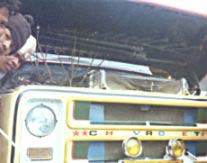
From Bukitinggi a pretty hill town I took a day trip to the picturesque Lake Maninjau. I remember the bus more than the lake although it was a lovely place - Harmonis. Bus Lines had four Chevrolet buses, each fitted with 15-tone air horns under the bonnet. They were played by means of a home-made piano keyboard near the driver's left hand. You could hear your bus coming from miles away! Indonesian bus drivers only need one hand for driving!
I learned that Indonesian bus drivers are a very special breed. They are usually larger in size than an average Indonesian male. This results from endless free meals at roadside warung as a commission for bringing 40 customers! The meal break always lasts the duration of the driver eating his meal so it's advisable to sit fairly close to him. Don't ever get caught in the toilet when it's time to leave, you will be left!
© Held by Author