

Living in Indonesia, A Site for Expatriates

Check out What's New on the Expat Web Site
Information for foreigners moving to Indonesia

Home » Practical Information »

Individual/Personal Income Tax in Indonesia

Practical Information for foreigners, expats and expatriates moving to Indonesia - find out about housing, schooling, transport, shopping and more to prepare you for your stay in Indonesia


Translate this Page

Bookmark and Share
Links to hundreds of articles giving practical information for expats moving to Indonesia
Post your questions or communicate with other expats in Indonesia on the Expat Forum
Looking for a place to stay in Indonesia - check out the Housing Forum
Looking for a weekend or holiday getaway ... visit some of Indonesia's Great Escapes
Some great restuarants in Jakarta
Advice and resources for conducting business in Indonesia
Info on expatriate community organizations in Indonesia
Shops, Products and Services
Links to other useful Indonesian or expat-related web sites
Expat Humor - spread the joys of Living in Indonesia through e-postcards
Site Map
Return to the Home Page
expatriate information for Indonesia

Working Tax Documents and Forms

This is a brief overview of the requirements, calculation and payment of personal income taxes in Indonesia.

The Employer's and Individual's Role in Personal Income Tax

Your employer is the body responsible for the calculation, payment and annual return of all employees for the year in question. Under the old system, the income tax of an individual who only has one source of income was processed by his or her employer. Employers were able to pay the tax of all their employees under one NPWP number, assuming that employees only had this one source of income.

Now things have changed ... the individual taxpayer is legally responsible for ensuring that they've registered with the tax office and comply with the regulations and payment of the tax due.

Employers have three choices for the personal income tax calculation:

  1. Employee's salaries are classified as Gross and tax is calculated on this, withheld from employee and paid via the banking system to the tax office.
  2. Employee's salaries are classified as Net and then grossed up to establish a gross amount from which the tax is calculated to bring the remainder back to the net amount as expressed in the employment letter.
  3. The tax is calculated on the net and treated as a fringe benefit.

Of special concern to expatriates whose salaries were quoted and paid net ... though your employer may have agreed in your contract to pay your taxes - you are still personally liable for their payment. Ask your employer to show you receipts showing that taxes have been paid for you on a monthly basis. The form required is 1721-A1, which is the actual annual return and a S.S.P. which is the actual proof of payment. It's very good to have your package expressed as gross. It then is defensible that as you only received the net amount the employer has deducted tax and is therefore liable for the payment to the Tax Office.

Those expatriates working for local PT companies (not the case for multinational firms) may find that in the past their employer “negotiated” their tax with the tax officials. This could come back to haunt you in the future. If your salary was quoted net, and you felt your local employer had paid your taxes according to your agreement, you may find in fact that the taxes were not paid and you are now liable for back taxes.

Each employee is supposed to receive their monthly tax calculation from their employer, and at the end of the year or the latest by March of the next year, the company has to produce Formulir 1721-A1, which summarize how much taxes the company has been paying for each employee. The employee needs to use form 1721-A1 to be included in their personal annual income tax return.

NPWP ... The Tax Identification Number

Since 1984, the tax office has required all resident individuals in Indonesia to have their own personal tax numbers, Nomor Pendaftaran Wajib Pajak or NPWP. This regulation includes expatriates. Naturally this excludes young children who are too young to work.

This regulation has not been enforced in the past due to the reliance on individuals having no source of income outside their employment or whose earnings fall outside the minimum level for inclusion in the tax scheme. The government assumption was that companies were paying the tax for their employees but in fact it wasn't happening in many local firms.

In 2000, the tax office stepped up the drive to require all expatriates resident in Indonesia to register with the tax office and obtain their own separate tax number (NPWP) and pay monthly taxes and file annual tax returns, and pay tax on their income earned outside Indonesia, less tax paid in other jurisdictions on the additional overseas income.

The government defines an individual taxpayer, who is required to register for NPWP and file income tax returns, as:

  • Employed individuals who earn income in excess of the non-taxable income,
  • Employed individuals who receive income outside of their main salary,
  • Individual taxpayers who receive income from trade/business activities, self-employment or exercise of profession;
  • Individual taxpayers who receive income from capital; and
  • Foreigners who reside or present in Indonesia for more that 183 days within a single period of 12 months or who are present in Indonesia and have the intention to live in Indonesia. This 12 month period is based on today going back 12 months. It is not a calendar year. (The “intention” to live in Indonesia is seen by such actions as applying for a work permit, owning or renting a house for an extended period, and bringing family members to Indonesia.) Please be advised that, according to the law, those who must pay Indonesian income taxes if they've been here the 183 days in a calendar year, includes, those expats here on KITAS, KITAP, business visa or social/visit visas!
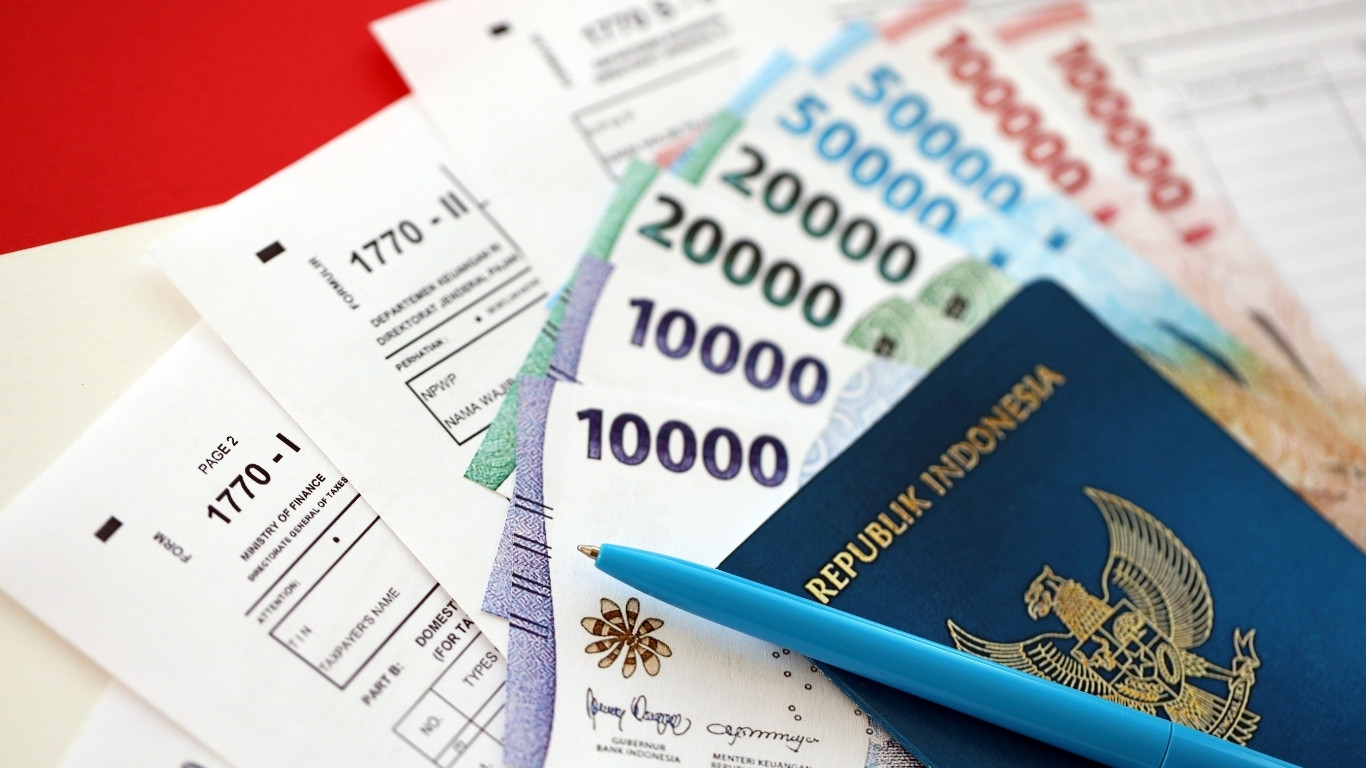
  • If you stay less than 183 days in a year, then you may not be obligated to pay Indonesian income tax (only taxes from your home country).. You must prove it by showing your visa stamp and fill out FORM 1770 Individual and Monthly SSP (Surat Setoran Pajak). Of course you must have an income tax number first to complete this form.
  • Dependent spouses are included in the husband's tax number and do not have to have a separate number.

Where to Register

Taxpayers must register at the Tax Service Office in your city of residence. Expats living in Jakarta are required to register with the Tax Office for Foreign Bodies and Expatriates (KPP BADORA).

Your registration, monthly tax payment and annual return can be prepared and submitted by appointed representative, usually an accountant specializing in tax matters. Be sure that you receive a good referral, as remember you yourself are accountable for any non-payment of taxes.

To register you need:

  • a completed registration form
  • photocopies of all the pages in your passport
  • photocopy of your work permit
  • certificate of domicile for you and your employer
  • photocopy of your employer's NPWP
  • Letter of Authorization, authorizing your representative to register and handle your tax matters.
  • While the registration form only asks for copy of ID page of passport and does not request the other items mentioned above, the bureaucrats at the Tax Office ask for them as a matter of course.

Once you have registered, taxes are due and payable beginning not later that the 15th day of the following month and reports should be submitted to the tax office by not later than the 20th day of the same month.

Enforcement and Linkage of NPWP to other Activities

In Year 2001, the Indonesian tax office renews its drive to widen the taxpayer base by registering all Indonesian Nationals for their own NPWP number. They have started linking this requirement to certain other registrations and regulations to enforce it.

NPWP may be required for a variety of other activiites:

  • buying a motorbike
  • getting a driver's license
  • building a house
  • opening a bank account \
  • renewing registration of a vehicle over a certain value
  • having a credit card limit in excess of a certain amount
  • payment of housing tax on houses over a certain value
  • applying for a passport (for Indonesians)

Let us know if you have other occasions (besides those listed above) where you, as a forienger, are required to present an NPWP. We'd like to forewarn others !

What Income is Included

The Indonesian personal taxation system is based on worldwide income. This includes:

  • Any salary paid to you for your current position, whether it be onshore or offshore
  • Dividend and interest income, both onshore and offshore
  • Rental income both onshore and offshore
  • Capital Gains from Sale of Property, both offshore and onshore

Benefits in Kind are generally excluded: Housing, Cars, School fees, as well as income from inheritance. However, if your company pays you for housing in one lump sum, and then you make the payments ... the tax office may construe that lump sum as income. In this case, it may be better for your employer to pay the housing costs direct to the landlord. You take the money as an advance, not as housing allowance. The company then expenses one month at a time as housing, which is then treated as a fringe benefit.

Credit is given for income tax paid overseas, subjected to limits and perhaps dependent on double taxation treaties between Indonesia and your country. You may also receive credit for tax taken on interest income for local bank accounts and time deposits and other interest earning methods that are taxed.

Since income from Overseas Investment can be taxed, it is best to consult your accountant and your financial consultant to determine how these new regulations will affect any current and future investment strategies.

Tax Rates

Taxable Income

Rupiah Rate

Rp 1-25 million 5%
Rp 25 to 50 million 10%
Rp 50-100 million 15%
Rp 100-200 million 25%
over Rp 200 million 35%

Deductions for an individual are Rp. 2,880,000, wife 2,880,000 and up to three children Rp. 1,440,000. Position Expense (Biaya Jabatan) is a deduction with a maximum 5% from gross income or a maximum of Rp 1,296,000.

If your company pays for house rental, car, etc. then it could be considered your income, or not. It depends on how the company will treat the expense. It may go to your income tax report as an income, or may go to the company income tax report as an expense. There are no exemptions for personal house rental, car, etc. Insurance premiums paid by the company are seen as additional income. Check with your tax professional to ask their advice on these perks that could be considered additional income.

You will receive credit against tax due for local tax prepayment through FISKAL departure tax, so save those receipts.

Consequences of Tax Registration

Many expats are used to being taxed on worldwide income but the Indonesia system is far broader than first meets the eye. As a registered tax person (body) you become liable for the full range and consequences of the system:

  • You will be required to do an annual return on your servants and drivers that are your personal employees and not on the company payroll.
  • When you rent a bus for your group's tour you will withhold tax from the bus company.
  • When you receive an advance from your company to rent a house/apartment you will be required to withhold tax from the owner.
  • You will pay the appropriate amount of tax via the banking system to the tax office and give proof to the person/company that you withheld from.
  • You will do monthly reports to the tax office concerning this.
  • You will make monthly payments on your own extra income and make an annual return.
  • By virtue of what you do outside employment or as self employed, you may also be liable for registration for PPN (VAT/GST).
  • Understand too that once the tax office has your personal residence and employment information, individuals from the tax office may choose to approach you on an individual, personal basis for various reasons.

Failure to Register

According to the regulations, failure to secure an NPWP could mean imprisonment for a maximum of six years and a maximum fine of four times the total amount of tax due. Audits could be conducted on past years and would rely on local and overseas tax statements and bank records.

Canceling Your Tax Number

Once you are registered you can only cancel the NPWP number by having a tax audit. This will be extremely difficult as it take 2 - 3 years for the tax office to perform such audit meanwhile your new job in another country is beckoning. Or you are returning home. The government cannot keep you in Indonesia until the audit is completed as your immigration papers will expire. But they may hold your personal shipment until such time as the audit is completed.

Double Taxation Agreements

The Indonesian Tax Office has the authority to contact the tax offices in countries that have a Double Tax Treaty with Indonesia to ask for information about you from their database. Likewise your country can ask for information from the Indonesian Tax Office, if there is a Double Tax Treaty in place.

Other Taxes

The DPKK is a tax that is paid by your employer to the Manpower ministry ostensibly to be used in training Indonesian workers. The cost is US$100/month and must be paid in full as a part of the process for obtaining a work permit. It is separate from and has nothing to do with an expat's individual income taxes.

Working Forms used to help prepare your tax information

Caution .. forms filed with the Indonesian tax authorities must be in Bahasa Indonesia ... these forms below are just meant to be “working forms” to give to your tax preparer.

Form 1770 - Annual Individual Income Tax Return (Word fileMS Word 285 KB)
Form 1770-I - Calculation of Domestic Net Income (Word fileMS Word 108 KB) (1770-I Page 2)
Form 1770-II - List of Tax Withheld or Collected (Word fileMS Word 236 KB)
Form 1770-III - Income subject to tax and non-taxable income (Word fileMS Word 249 KB)
Form 1770-IV - List of Assets and Liabilities (Word fileMS Word 226 KB)

Form 1770S - Annual Individaul Income Tax Return - For indidivuals who do not conduct business/independent work (Word fileMS Word 244K)
Form 1770S-I - Details of Net income and list of withholding tax (Word fileMS Word 247 KB)
Form 1770S-II - List of assets and liabilities (Word fileMS Word 141 KB)

Indonesian Income Tax Law of 2008 and Tax Law Amendment

Website for the Directorate General of Taxes - Republic of Indonesia

How to find a tax consultant

Most of the large international accounting firms have staff that can help you to prepare your taxes, both Indonesian and foreign.

We suggest you contact the business association that relates to your nationality and ask them to recommend one of their members that works in the accounting/tax field.


Housing and schooling information for expats in Indonesia expatriate website for Indonesia Indonesian language translation of article
Practical Information for foreigners, expats and expatriates moving to Indonesia - find out about housing, schooling, transport, shopping and more to prepare you for your stay in Indonesia

Practical Information  |  Expat Forum  |  Site Map   |  Search  |  Home Page  |  Contact


Return to top

Copyright © 1997-2010, Expat Web Site Association Jakarta, Indonesia http://www.expat.or.id All rights reserved. The information on Living in Indonesia, A Site for Expatriates may not be retransmitted or reproduced in any form without permission. This information has been compiled from sources which we, the Expat Web Site Association and volunteers related to this site, believe to be reliable. While reasonable care has been taken to ensure that the facts are accurate and up-to-date, opinions and commentary are fair and reasonable, we accept no responsibility for them. The information contained does not make any recommendation upon which you can rely without further personal consideration and is not an offer or a solicitation to buy any products or services from us. Opinions and statements constitute the judgment of the contributors to this web site at the time the information was written and may change without notice.