Living in Indonesia, A Site for Expatriates
Check out What's New on the Expat Web Site
Information for people relocating to Indonesia
Links to hundreds of articles giving practical information for expats moving to Indonesia
Post your questions or communicate with other expats in Indonesia on the Expat Forum
Looking for a place to stay in Indonesia - check out the Housing Forum

Aida Speaks Out
Practical Information for foreigners, expats and expatriates moving to Indonesia - find out about housing, schooling, transport, shopping and more to prepare you for your stay in Indonesia

Comedy in a Blanket

Looking for a weekend or holiday getaway ... visit some of Indonesia's Great Escapes
Some great restuarants in Jakarta
Advice and resources for conducting business in Indonesia
Info on expatriate community organizations in Indonesia
Shops, Products and Services
Links to other useful Indonesian or expat-related web sites
Expat Humor - spread the joys of Living in Indonesia through e-postcards
Site Map
Return to the Home Page


Indonesian jokes are not funny. No, let me rephrase that. Indonesian jokes, told in the Indonesian language are not funny. And yes, I do speak and understand the Indonesian language perfectly, but I still don’t think Indonesian jokes are amusing. The only ‘Indonesian’ jokes that are a tad cynically funny are the ones recited by the long-term expatriates periodically burnt by their local experience, like this one: A Singaporean and an Indonesian man took a creativity test and they were sent into separate rooms to take the test. Inside each room there were two tools. The men were asked to make something useful with whatever they could find in the room, using the tools. One hour passed. The Singaporean man stepped out of the room, showed the jury a state of the art, albeit blatant copy of an American gadget he had created. Two hours passed. The Indonesian man walked out of the room and told the jury that he lost one tool and broke the other.

Yesterday I searched the net for an Indonesian joke, I couldn’t find a single one that could make me laugh my head off or simply giggle non-stop with tears in my eyes. Well I actually had tears in my eyes, but the reaction was more due to the pathetic phrases I read on the screen.

Why is it so tough to find decent local jokes in this country? I am not talking about the sexist jokes the men in Indonesian offices tell their staff, which are usually followed by a chorus of fabricated laughter (because if you don’t laugh you will be excluded from the vertically challenged group of the powers to be). I am talking about fresh humour, generated by people of various classes reflecting their experience of daily life, clever words relieving them temporarily from the harsh realities of life in this prolonged economic crisis.

Is humour not a part of the Indonesian culture? Has it ever been?

Indonesian humour (read: jokes told in the Indonesian language) is divided into four categories. They are 1) slapstick, 2) heavy in racism or 3) commonly use wordplay, and 4) the intellectually challenged. Slapstick jokes are frequently broadcast on local TV, in Bajaj Bajuri TV comedy series for example, where people falling off a chair and a vomiting baby are considered hilariously funny. Racist jokes are the second favourite type of humour in Indonesia. The supposed ‘jokes’ are usually about a non Chinese-Indonesian dressed up in a Chinese costume speaking Indonesian with an inflated Chinese accent, a non Batak man shouting brusque sentences with a heavy Batak twang. These are often seen on TV and heard on radio, under the banner of integration propaganda instead of racism. About the intellectually challenged Indonesian jokes - the least said the better.

Watching a Comedy Club show a few months back, it struck me that the stand up comedy show in Indonesia was not only monopolised by western comedians. Not only by the Irish who tend to incorporate the F word in every joke or by the Australian blokes who keep inventing new words like ‘Smee’. In fact in the 80s, Indonesia had a stand up comedy mogul who originated from Srimulat, a traditional comedy group. His name was ‘Gepeng’, contrarily means ‘Flat’ or ‘Squashed’ in English, God bless his soul. He was a hilarious stand up comedian, a comic genius with lots of clicking funny bones.

Srimulat emerged in Solo in 1950. The group roamed and gave performances from one town to another in Java achieving national acclaim in Surabaya by 1961. Gepeng was the leading clown of the group. In every performance, Gepeng stepped out onto the stage first, he always played the role of a servant in the house of an aristocratic family. Wearing moronic make up, Gepeng dressed in a servant uniform with a dirty towel slung over his shoulder. He sat down, looked at the audience with his well-known smirk, and began his funny spiel in Javanese, punctuated with a bit of Indonesian here and there. He could hardly speak the Indonesian language properly. He was so refreshing because unlike most stand-up comedians, Gepeng’s jokes were not solely based on reduction and diminishing tactics. Today, a number of Srimulat trained comedians, like Basuki. Kadir, Asmuni and Tarzan, are still on the move and have captured the attention of Srimulat’s huge number of fans.

I believe that humour has been and still is a strong part of the Indonesian culture, but it mostly evolves traditionally underneath the hustle and bustle of the nationalist drive to use the national language. The fact is, people have to understand English to understand Seinfield’s jokes, people have to understand Javanese to understand Javanese jokes. Just like Balinese jokes or the Malay’s comic ‘pantun’ in Sumatra, most of them are untranslatable. Humour is behind every word; once you change the words into a different language, you usually lose the humour. What may be funny in one language or one culture may not be funny in another.

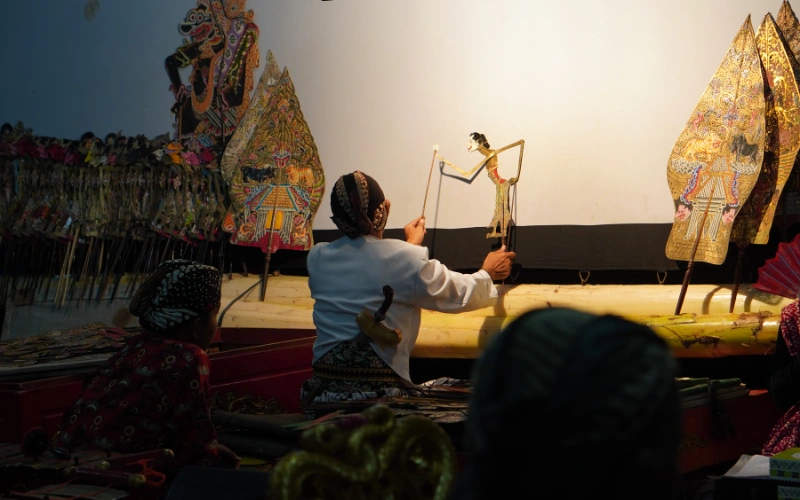
Ancient evidence that humour has been propagating in this country is the existence of the Javanese Punakawan. The Punakawan are the unique characters found in the Mahabharata epic, in both the Javanese and Balinese versions. In Java, the Punakawan are made up of the hilariously funny brothers, Gareng the limping man who always manages to say the wrong thing, Petruk who likes to ridicule atrocity with his humour, and Bagong, the dim-witted, insipid shadow of his father. Semar, the father and the wise caretaker of the Pandawa who has a supernatural ability that is greater than the gods, always joins his sons at the end of every scene to straighten up the twisted wisdom jocularly narrated by the sons. Around the 13th century, when Majapahit was in power in the archipelago, the son of King Brawijaya created the Punakawan characters we still enjoy today. The formerly depressed commoners took comfort from the funny shows and further developed the funny characterizations from one generation to another. Nowadays, many Indonesian men think that they are reminiscent of Semar, though their behaviours are more like Petruk, Gareng or Bagong.

Stand up comedy in Indonesia is not only monopolised by western comedians.

In a nutshell, comedy in Indonesia has been a strong part of Indonesian culture and has developed over the centuries. It’s not so obvious now, because it’s hidden under a layer of the newly introduced national language.

Do you want to hear a funny Indonesian joke? Learn the local dialects.

First published in Jakarta Kini.

Read back issues of Aida's articles:

The Kampung Foreigners are Here!
I’m Dreaming of the Good Old Days
Stuck in Between Horse Carts and GPS

English versus Indonesian: Less Nationalism?
No more Apathy Please!

Have you seen my G-spots lately?
The Smart Balance between Stressful Life & Release

Mutation: from Giraffes to the New Virus Strain
Is Life Cheaper than a Stronger Seedling?

Disasters, Where Art Thou?
One Day at the Zoo
Not all Local Men are Nut Scratchers!
Amusing Creativity & Innovations in Names
Mike, Myself and I

Older None the Wiser
The Great Suckers
Golden Curry - Kinara Restaurant Review
The Quick Fix
It's Definitely Not my Fault!
New Hairdo, New Culture

The Mozzarella Bubbles in Pondok Indah
The Wrinkled Coconuts
Peculiar Questions
Is it Deterioration or Too High an Expectation?
Java Bleu - Where the Chefs Dine.
Snobbish Reviews on Local Warung - Why Not?
Valentine's Day - Why Does it have to be Pink?
It's My Life
Who Says Indonesian Girls are not Flexible?
You Suck when you're Drunk!
Being equal or simply being trashy?
Café Au Lait: the Favourite Flavour in the Glam Industry
New Business Opportunities
Mary's Star Deli
A Woman's Perspective on Pregnancy
Getaway Dream Turns to Ashes
The Sexy Career Barbie Syndrome
Kemang: From Clay Pots to Hotspots
Split Personality: Another Lame Excuse
My Snakes and I
The Joy of Humiliating Moments
What's a Sweet Boy Like You Doing in a Sleazy Place Like This?
Latest Dress Code While Clubbing
My New Year's Resolutions
When Another Harry Met Another Sally
Twofold Holy!
One day, when she had it pierced ...
The Latest Trend: Date a Bule?
Road Rage, Blame it on Adrenaline
The Beauty of Bustling Conversations
She's Indonesian, Beware
Detox Frenzy
My Ex-Mate Mr. Bean
Bobot, Bibit and Bebet
Women, Sex and Prejudices in Jakarta
Craving for Local Foods
Been Flying Lately?
Cinderella Stories
Special Service, Mister?
A Dog's Life
Health Clubs: To Be Or Not??
Today's Special: Good Food & Service
Between Catwalk and Reality
Warning for Naïve Male Expatriates
Talking about men, chauvinism and discrimination
While I was having my hair done ...
Dream House Hunting

information on moving to Indonesia
Practical
[Practical Information] [Expat Forum] [Site Map] [Search] [Home Page] [Contact]

Tell a friend about the Living in Indonesia web site

Return to top
1997-2010, Expat Web Site Association. Jakarta, Indonesia http://www.expat.or.id All rights reserved. The information on Living in Indonesia, A Site for Expatriates may not be retransmitted or reproduced in any form without permission. This information has been compiled from sources which we, the Expat Web Site Association and volunteers related to this site, believe to be reliable. While reasonable care has been taken to ensure that the facts are accurate and up-to-date, opinions and commentary are fair and reasonable, we accept no responsibility for them. The information contained does not make any recommendation upon which you can rely without further personal consideration and is not an offer or a solicitation to buy any products or services from us. Opinions and statements constitute the judgment of the contributors to this web site at the time the information was written and may change without notice.